This week the Pole Barn Guru tackles reader questions about a building set into a slope with use of post brackets, the possible use of “cross bracing” for wall girts, and understanding pressure treated wood.
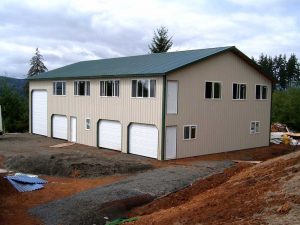
DEAR POLE BARN GURU: I would like to build a 32′ x 48′ 2 story pole building where two of the sides of at least the lower floor are at least partially set into the hillside on the property. I envision the two sides set into the hill to be concrete foundation walls. Sort of a daylight basement. The lower floor would be a woodshop and the upper floor a two bedroom apartment. I am assuming a concrete foundation with Laminated “poles” mounted in brackets as opposed to buried. the “poles” on the two sides set into the hill would be shorter than on the other two sides. With the available space, the two story concept works better than having everything on a single story. Is this even possible? What would a ROM cost for a kit like that cost?
Thank you BILL in WEST RICHLAND
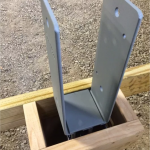 DEAR BILL: Your idea is totally possible. I have done it myself. In my case I had 12 feet of grade change across my building’s 40 foot width. I used ICFs full height on one sidewall and stepping down across rear endwall. Columns on these two walls were mounted using wet set brackets, other two walls had embedded columns. This process could also be used with poured concrete or block walls. We have also developed a system to use columns placed in a permanent wood foundation.
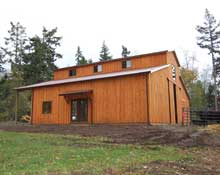
Attached photo is of my own building.
This is being shared with your Hansen Pole Buildings’ Designer who will be reaching out to you shortly.
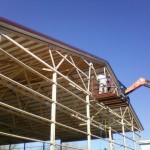 DEAR POLE BARN GURU: When using bookshelf girts is cross bracing used between posts or are the girts when blocked provide the support? WINSTON in MOULTON
DEAR WINSTON: No cross bracing is required when using bookshelf girts. Once installed (ideally blocked solid to columns at each end) and sheathing (OSB, plywood, structural panels or steel siding) is applied, your wall and girts are more than adequately supported and this assembly is fairly rigid.
DEAR POLE BARN GURU: I read the article regarding treated wood. I am still a little puzzled as to what treating you would use for ground contact purposes, especially the upright poles. Do you have any other articles regarding this subject or have input you could email me? Much appreciated, thank you. KELLY in VICTOR
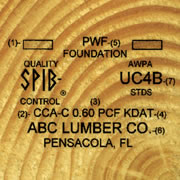
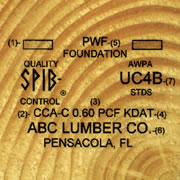 DEAR KELLY: Pressure preservative treated wood standards can be confusing even for lumber dealers, professional builders and building inspectors. For structural building columns, all end tags should have UC-4B marked on them. UC-4B is for “Heavy Duty” use. This American Wood Preservers Association infographic might prove helpful to understanding proper uses for pressure preservative treated wood: www.awpa.com/images/standards/ResidentialInfographic2020.pdf
 Reader MATT in PIERRE writes: “Is there any possibility that the ICC will adopt an appendix related to pole-frame buildings. We require engineering in our local jurisdiction at this time and it would be much simpler for customers who want to build a pole-barn if there was a way to construct these buildings without engineering. They do have an appendix for straw bale houses, of which I have seen exactly 0. Thank you!”
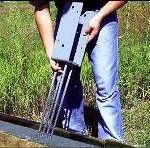
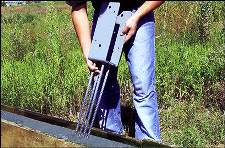 DEAR JASON & ERIN: Your plans did not arrive as an attachment, so I am unable to speak to them. If your concern is with properly pressure preservative columns prematurely decaying when embedded in ground, then Permacolumn Sturdi-Wall Plus brackets are indeed your best design solution. Unlike other, cheaper, brackets, these actually will resist moment (bending) forces and have ICC-ESR approvals as being Building Code conforming. For extended reading on Sturdi-Wall Plus brackets:
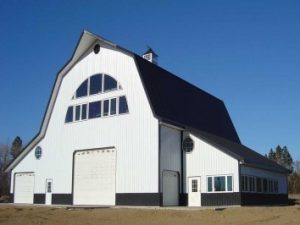
  DEAR POLE BARN GURU: How tall would a barn have to be to accommodate horses on the bottom and eventually a 2 bed 2 bath apartment in the loft? JUSTINE in LITTLETON
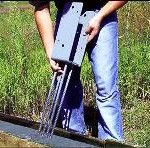 DEAR TAMI: Provided footings beneath your CMU wall are adequate in dimension, probably. In areas of your existing wall where ICC ESR approved engineered wet-set brackets for columns will be placed, existing blocks will need to be removed and replaced, so brackets can be properly poured into wall.
 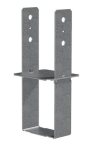 DEAR POLE BARN GURU: I see a lot of discussion about using the Sturdi-wall wet set bracket when using a concrete pier for posts. I was wondering if the Simpson CB (column base) is used in post frame construction? From their documentation it looks like that is what it was designed for. RON in HILO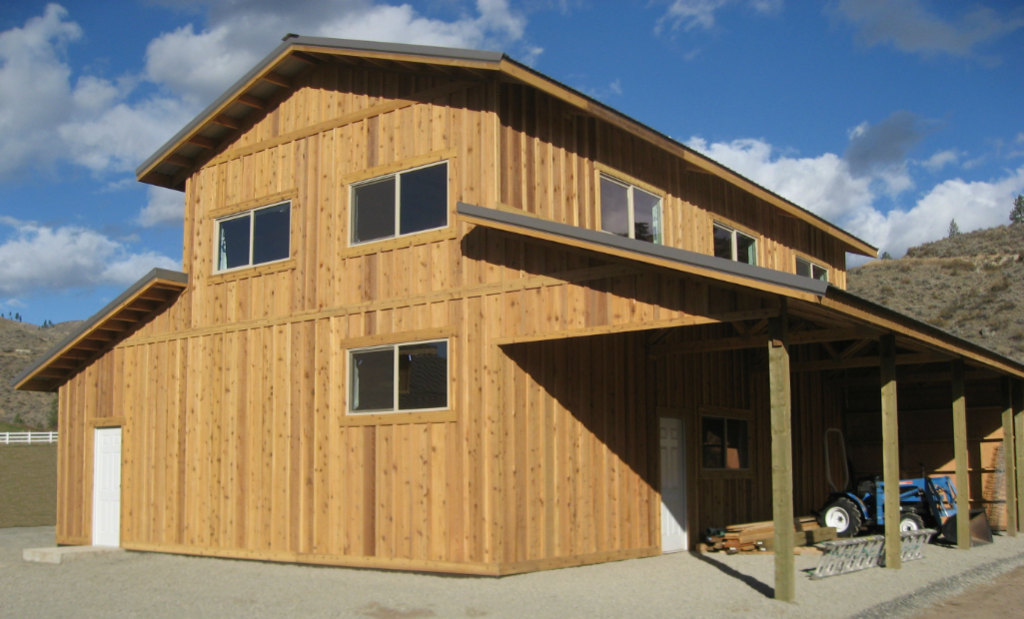
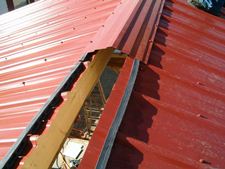 DEAR POLE BARN GURU: I have a barn that doesn’t have soffit vents but it does have a ridge vent. I installed reflective insulation which seems to have dropped the temperature quite a bit. I also have a gable powered fan that does 2000 CFM. However it is about 8 to 10 feet lower than the ridge vent. Are these two things fighting each other do you think or should I take a pipe and vent it up to my ridge vent and to my fan to take the hot air out from the top or should I turn my gable fan off completely.
 DEAR LOUIE: Drives me absolutely bonkers when providers or builders make no true efforts to advise customers on perils of condensation and how to prevent it. So easily, and inexpensively, done at time of construction.
 DEAR DENNIS: Properly pressure preservative treated columns, embedded in ground are unlikely to decay within lifetimes of anyone alive on our planet today