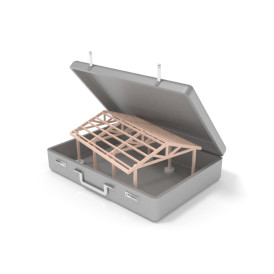
This week clients “Ask the Guru” advice on adding a 16×16 post frame on to an existing structure, if Hansen can design for a 180mph wind load, and advice on ceiling insulation.
 DEAR POLE BARN GURU: I live in a tiny house and would like more space. Adding on a 16 x 16 foot room to the back of my house would give me more living space. My question is can this room be customized to look like a family room cheaper than a stick built add on? Thank you very much. P.S.:I don’t have any photos because I am in the thinking stage of this idea. REBECCA in CHANDLER
DEAR REBECCA: Post frame will be your most cost effective permanent structural system, regardless of scale. All interior spaces will finish identically – stick or post frame.
DEAR POLE BARN GURU: Are there any designs rated for 180 mph wind loads for hurricane prone regions? CHASE in GULF SHORES

DEAR CHASE: With our structural systems virtually any design can be engineered for 180 mph (or even greater) wind speeds.
DEAR POLE BARN GURU: My pole barn is 32×22 with a concrete floor,I insulated the walls with 2″×4×8 sheets with foil on one side facing the siding. I have a ridge vent and sofits. I want to install metal liners on my ceiling. The question is I want to use R49 insulation bats do they need to be faced or can I use unfaced. The building is not heated I plan on heating it with a portable heater if and when it’s necessary. The building is used to store a classic semi truck and a place to work on it. I live in northeast PA. MARIA in CATAWISSA
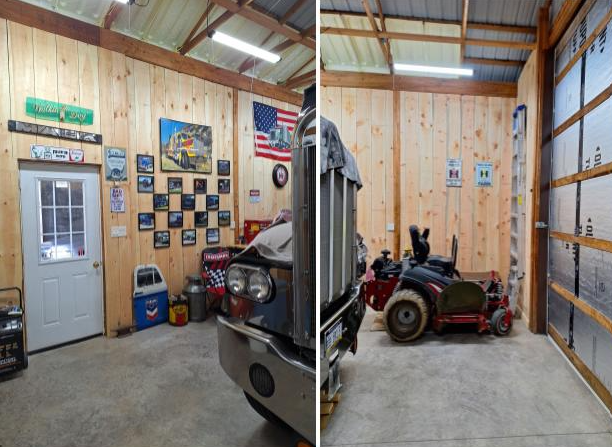
DEAR MARIA: Provided you are using fiberglass or rockwool batts they should be unfaced. Make sure to leave at least an inch of clear airspace above insulation and below roof plane.
 Reader ERICA in WEST COLUMBIA writes: “Is there a specific bubble insulation brand you recommend? We will be using this as our vapor barrier in the roof. I’ve seen posts about this type of insulation disintegrating, so I’m wondering if the claims are exaggerated or if in fact it could be a certain brand. Also we are wanting to have cathedral ceilings throughout our building. Our roof is made with metal trusses and wood purlins. We are using bubble insulation and some type of batt insulation. What is the best method to vent if we are not going to have an attic space?”
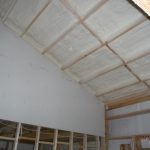 Instead, look at spraying two inches of closed cell spray foam directly to underside of roof steel (between purlins), then fill balance of purlin cavity with unfaced rockwool batts. This will get you a higher R value and save on material and labor for a lot of 2×4. You should not vent either eaves or ridge in this case.
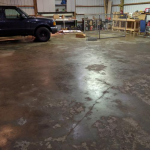 My concerns for your workshop area are going to be ones of moisture – although your slab on grade has been sealed, it has no vapor barrier underneath, so you are probably yet going to have moisture passing through. Heating with either propane or kerosene will be adding even more moisture into this area.
 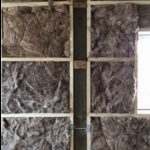 I would look at design solutions allowing moisture to pass out of your workshop, and not in. For those interior walls, unfaced Rockwool batts, with a housewrap on the cold storage side of studs. Ceiling, if you can find it, use blown granulated Rockwool, as it is unaffected by moisture. Otherwise use Rockwool batts, overlaying layers 90 degrees to each other.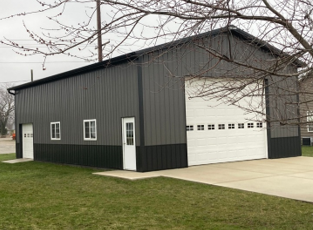
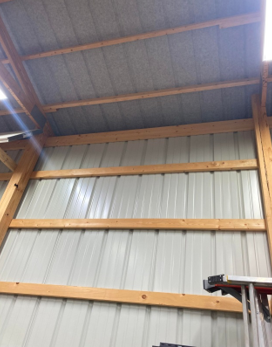
 Robertson County is in Climate Zone 4A, where 2021 International Energy Conservation Code (IECC) requires R60 in roofs and R30 in walls. You can meet wall requirements with 7-1/4″ Rockwool (
 Welcome to challenges of trying to get adequate insulation when finishing the underside of roof purlins.
 First – you are putting a 58 foot wide door in a 64 foot endwall. This leaves only three feet of solid wall on each side of your door opening. These areas need to be shearwalls and maximum aspect ratio for a shearwall is 4:1 (four feet of height for every foot of width). With a three foot wide shearwall your maximum opening height would be 12 feet. You are likely to experience some tremendous racking problems (if not a failure) on your door endwall.
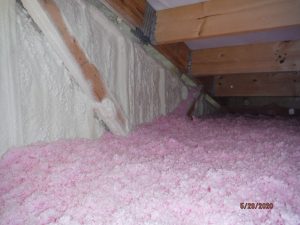
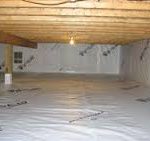 You could condition your crawl space – this would require a 6mil or thicker, well-sealed vapor barrier to cover underlying soil and up perimeter walls to floor joists. There would be no vents with this method, however an air-circulating device must be provided. Perimeter walls should be insulated using either closed cell spray foam or rock wool batts.