My good friend John used to own (among other things) Heartland Permacolumn. Six years ago, I borrowed this from his website:
“Perma-Column products give you the ultimate price advantage. You simply cannot put up a building on a concrete foundation for less money.”
Yet some may say, “They’re too expensive…”
HOWEVER, the only people who ever say this install buildings using treated wood posts embedded directly in the soil. They think adding between one and three thousand dollars to a building makes the price “outta sight…”
It is true that there is one type of building that is less expensive than a Perma-Column building…one built on a treated wood foundation. Treated wood posts may last a very long time in soil contact in some cases…and not so long in other cases. This is part of what makes post-frame buildings the most economical of all building types.
But there are several other reasons why post-frame is so economical and efficient. First, it is much quicker, easier and less resource-intensive to stick a post in the ground and build from there than it is to build any other type of building on a typical foundation.
Second, by using posts that are 8′ or more on center, you have far fewer structural members to install compared to other types of buildings.
Third, because the structure is made of wood it is less costly, requires no fancy equipment or specialty trades, is easier to work with, is very environmentally-friendly and is energy-efficient.
Furthermore you can build exceptionally high sidewalls (usually 24′, sometimes more) and exceptionally wide clear-spans (100′ or more without supporting walls or columns) for ultimate design efficiency and flexibiliity. All of these advantages remain firmly in place when you build on concrete piers or a continuous concrete foundation using Perma-Column products.
When one takes a close look at costs per linear foot, the upgrade is not really very much at all. A Perma-Column upgrade is typically between $10 and $11 per linear foot compared to the price of building on treated wood posts embedded directly in the ground. This may increase the price of a really small and inexpensive agricultural building by more than 10%, but it may also add less than 4% to the total cost of a really nice one…or to a typical commercial, residential or industrial building.
So if you want a REALLY cheap building and don’t care when or if the post foundation will rot, you should build a post-frame building on a treated wood post foundation…
…or for roughly 10% more, you can build using Perma-Columns and have an investment that will hold its value for a very, very long time.”
Mike the Pole Barn Guru writes:
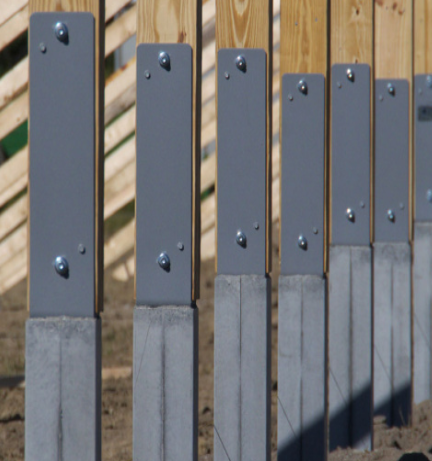
Perma-Column
This particular article has been triggered by a question posed by reader MATT in WABASH who writes: “What is the cost of a perma-column? I am looking at a 40 x 56 building most likely at a residence that I will live long term and thought perma-columns would be a good investment, but I am having trouble finding the cost online for them. Thanks!”
Well Permacolumns are available on Amazon.com (https://www.amazon.com/PC6300-2×6-Perma-Column-Foundation-Certified/dp/B0DQ2N6NSF/ref=sr_1_6?adgrpid=1344703912547853&dib=eyJ2IjoiMSJ9.0MVCt2dT_CsHMhbljq-CF01YTTjA7PpDBMQYmdzsTfJl_pZZrbcB4dhN6SCNG9Ug5mtzTwisB6GC_htPS1dEiWpHjkgTo8pkGhjjoFeFpdjNccpHLWq7kWqlNDbdhWka8JppLWBDghx1FMLvqdsZag.VCekjdK4fR0g698GAk751pXHjbJ64q_3DiY_kxUWVhQ&dib_tag=se&hvadid=84044194321593&hvbmt=bb&hvdev=c&hvlocphy=56989&hvnetw=o&hvqmt=b&hvtargid=kwd-84044783183340%3Aloc-190&hydadcr=13551_13391994&keywords=perma+columns+for+pole+barns&mcid=47aef47c8e12351c8263a3a4c6013289&msclkid=dcfe1e0d477e11014aee76ebe4446827&qid=1759945545&sr=8-6), for $242.40 plus roughly another $100 per column in freight to be delivered to your jobsite. Next challenge is going to be unloading and properly placing these several hundred pound Perma-columns exactly in holes, on top of a poured concrete footing (yes, a footing below is still required).
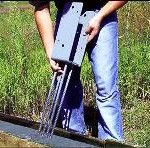
With a thought one is trying to avoid placing properly pressure preservative treated wood in ground, there may be a more affordable (and easier to install) alternative. Assuming four foot deep two foot diameter holes, one could pour under one-half yard of premix per hole and mount an ICC-ESR approved wet set bracket in it for roughly $175. Same longevity, same concept, easier to install AND ONE-HALF PRICE!
 DEAR POLE BARN GURU: I am interested in getting a simple 500 square foot pole barn residential home. In location of Lonedell, Missouri, Any guestimation on price? LORI in SAINT JAMES
 DEAR POLE BARN GURU: I am seeking affordable housing but am unfamiliar with pole barns. Where should I start to educate myself? I have questions like 1) what is the process of building one? 2) legality of the unconventional home (I live in South Carolina) 3) is financing a pain because it’s not the norm 4) do you offer services beyond just the building, things like drive, septics, and so on. MITCHELL in LANCASTER
  DEAR POLE BARN GURU: Is it possible to place a barndominium on a crawlspace? MICHAEL in GUSTON
 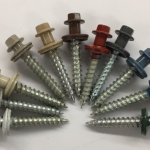 You should replace all nails with screws of a larger diameter than nails and 1/2″ greater in length. Look for screws with EPDM washers (not neoprene rubber). If you find a location where water leaks have caused wood deterioration and screws are not “biting” place a wood ‘filler’ in hole – we’ve heard of people using wooden match sticks for this purpose, however would recommend ripping some small squares (roughly 1/8″ square) out of Douglas Fir using a Table Saw.
 DEAR CRAIG: While it might be possible to raise a portion of the roof, it should only be done with involvement of a Registered Professional Engineer who can make a determination of adequacy of what you have, and what would need to be done to insure structural adequacy. Chances are good columns in area to be taller will need to be larger in dimension to properly withstand wind loads.
 o model Building Codes – IRC (International Residential Code) for one and two family dwellings and their accessory structures, and IBC (International Building Code) for all other buildings. Neither code has a requirement for full foundation to support pole (post frame) buildings. I would encourage you to reach out to your local Building Official to ask for further information – it is possible your village or township may have enacted a specific ordinance, to this case, if so – request a written copy of the approved document and please forward it to me for review. In most instances, no such ordinance exists and, if so, this ‘requirement’ cannot be legally enforced.
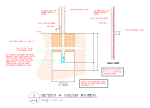 DEAR POLE BARN GURU: I have a new monoslab with 20″ footer all around. Slab is also reinforced with 1/2″ rebar. I want to build a 40’x46′ pole barn. Walls are 14′, roof trusses are 5/12 pitch. Can I use Simpson brackets and place 6″x6″ posts on top of the concrete every 8′ with 2″x6″ girts? Or should I have builder put posts in the ground around the slab? Thanks-ERIC in REXFORD
 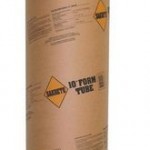 DEAR DIGGING: If you think about it, a sonotube filled with concrete and a bracket on top, is going to provide less lateral resistance than a column in a hole filled with concrete. Depending upon building dimensions, exposure to wind and soil conditions above the bedrock, it is very possible increasing hole diameter and using a complete concrete encasement could do the trick.
 DEAR POLE BARN GURU: would it be possible to do a dog kennel in a pole barn. Can air conditioning be used in a pole barn? In other words could a pole barn be properly insulated to be efficient enough to make it worth it? RICHARD in NAPLES
  DEAR POLE BARN GURU: What type of kennel designs have you done in a 36×48 or a 30×60? GERARDO in BLUFFTON
 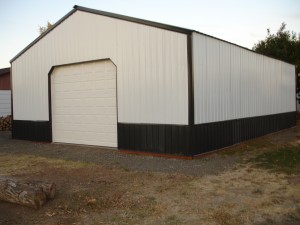 Starting with your door end (which I will assume is uphill), I would add enough fill so this end could have holes dug to 40″, filling balance of site accordingly. All fill should be compacted in no less than six-inch lifts to a minimum of 90% of Modified Proctor Density (you may need to invest in a Geotechnical Engineer to verify compaction).
 DEAR POLE BARN GURU:
  DEAR TONY:
 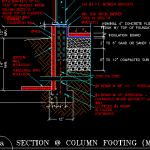 DEAR LLOYD: There is no structural reason to pour a “rat wall” between columns (