Post Frame on a Rock Pile?
Reader MIKE in MAINE writes:
“Hello ,
I am looking to purchase a Post and Beam Barn kit, but I have been advised by my excavator guy that I won’t be able to set the sonotubes in the ground due to the mixture of rocks sizes at my location
A bit of background:
The location is northern Maine and the soil composition is granite and clay, with poor drainage. Freezing line is probably at 8+ ft
The location chosen is a 75×75 area that has a pile of rocks collected from all over the old field years ago, and the suggested plan by the excavator guy was to grade that over a 75×75, add crushed gravel on top (10 inches or so) and when I told him I would need the sonotubes embedded at least 4-5ft down, he said I wouldn’t be able to dig the holes, but I won’t have any problems with heaving
This is an incorporated township, so there is no code requirement or enforcements (just as a fyi), but I still want to do things by the book for my own safety and investment protection
He suggested a perimeter sidewall of 12×12 and attach the posts to the wall with the perma column type brackets
My plan is to build at minimum a 40×50, ideally a 50×60 barn with porch around
I’ve uploaded a video of the site (as well as an alternative spot just across the road from it) and some still photos to help you help me divide what type of foundation do I need, and if it is in fact viable or doable
I would greatly appreciate your assistance with this before I commit tens of thousands of dollars into a kit I would not be able to build
 Mike the Pole Barn Guru writes:
Thank you for your interest in a new Hansen Pole Building, as well as for providing so much valuable information.
Your rock pile site would be far less than ideal for several reasons, beyond just an inability to auger holes through rocks. Biggest challenge would be this being a terrible surface to pour a concrete slab on top of. Adding crushed rock over this is going to leave temporary voids between those larger, underlying stones. Over time crushed rock will slowly filter into these spaces, now your gaps will be directly below your slab – forcing your slab to bridge across them. Without significant amounts of rebar being added, slabs are not going to perform well under this scenario. Be prepared for more than just minimal cracking.
Any uninsulated foundation not extending to below frostline is likely to present frost heave issues over time.
My vote would be to opt for your alternative site. I have previously penned a four-part series on site preparation starting here: https://www.hansenpolebuildings.com/2011/11/site-preparation/
You have several options for foundation:
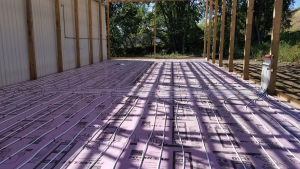
My favorite (also most cost effective and easiest to construct) – embedded columns. You can limit needed embedment depth to 40″ below grade by use of R-10 EPS insulation, going down two feet, then out another two feet.
Second choice would be using concrete piers with wet set brackets. Square piers can be formed out of EPS insulation (again to limit needed depths) with continuous insulation between piers. Sonotubes could be used, however they are difficult to effectively insulate, so it would be recommended to embed them to frost depth.
Please do not hesitate to reach out to me at any time with questions or concerns.
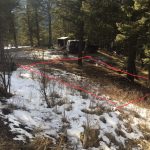 DEAR ASHLEY: A post frame home is certainly an excellent design solution for a slope building site. You do have some options (both of these I used on a personal building site of my own) – you can cut to create a ‘daylight’ or ‘walk-out’, or build on stilts.
 DEAR DAVID: Even building with a slab on grade is going to require excavation, as you need to have footings either extending below frost line, or thermally isolated to prevent frost heaving. Horizontal girts, by themself, provide little or no resistance to racking. Properly engineered, your steel roofing and board and batten siding can provide adequate shear resistance.
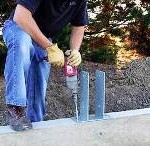 DEAR ALAN: There are plenty of folks out there who would gladly be willing to use dry set brackets to mount pole barn columns to your slab. In most instances, this is a less than adequate design solution as these brackets are not designed to withstand moment (bending) loads. (For extended reading, please visit
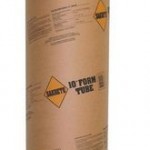
  How I would do it now – I would use sonotubes equal to or larger in diameter than what was specified by an engineer. Cut tubes to depth of hole length, then cover one end of tube with six ml black visqueen (read about visqueen history here:
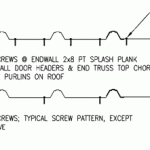
 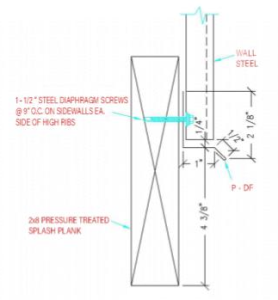 DEAR STEVEN: Your building’s grade board (aka splash plank or skirt board) will be oriented so upper 3-3/4 inches will be above top of slab. In this area, 10d common galvanized nails can be used. Below top of slab, fasten with two 3/16” x 3” Powers (
 DEAR CARL: Installation of housewrap will be a chapter in an upcoming version of our Construction Manual. Although it might be possible to install steel siding over cap staples, we are unaware of anyone who has tried it. To the best of our knowledge everyone has used just enough staples to hold housewrap in place and installed siding immediately. By running housewrap vertically you can place wrap right ahead of installing steel. Make sure to seal all seams with three inch wide tape.
 DEAR HARRY: We are not contractors, so could not assist with any form of construction. As post frame building kit suppliers, we do not use metal joists of any kind.
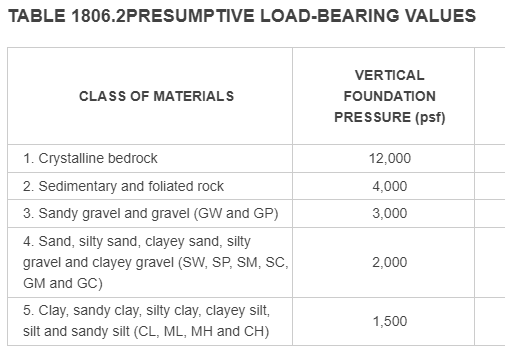
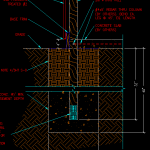 Even with good soil, your proposed 20 inch diameter concrete cookie is not adequate to properly distribute the weight of your building across the soil. Added to the challenge is the use of attic trusses which is going to further increase the loads on the footings. From the sound of it, a registered design professional (RDP – architect or engineer) has not been involved in the structural design of your building itself, as not only is your footing inadequate, but there is no provision made to prevent uplift issues.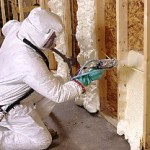
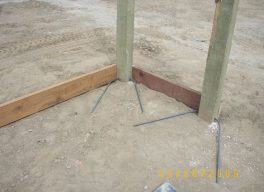
 “I looked at each of the suppliers of pole frame kits and was not impressed with the cookie base with treated pole foundation. I only found one that included a preformed concrete pillar with a top flange. I like this system. A little more labor and a wee bit more concrete but it seems to make for a better quality foundation. Whaddya think?”