Are barndominiums VA LOAN eligible?
A barndominium is a residential structure built in a post-frame shell incorporating living quarters, sometimes alongside a workshop, garage, or open agricultural area. National Association of Home Builders’ (NAHB) Housing Market Index builder survey published by NAHB’s Eye on Housing found 7% of single-family builders had constructed barndominiums in prior twelve months. Of those, 70% combined residential space with shop or workshop areas. This builder-adoption rate has climbed steadily, and for good reason.
Cost advantages are real. HomeGuide’s national cost data puts a finished barndominium at $65 to $160 per square foot for basic to mid-range finishes, with a 2,000-square-foot build running $150,000 to $315,000 and a national average near $230,000. Traditional stick-built new construction at comparable finishes runs $150 to $200 per square foot, meaning a mid-range barndominium typically comes in 20 to 35% below an equivalent stick-built home.
For veterans, appeal layers on top of any cost advantage. With a right barndominium parcel in a barndominium-friendly county, a VA loan’s zero-down requirement means you can move toward ownership without burning down your savings. Acreage flexibility is another draw as barndominiums typically are built on larger rural lots, this pairs naturally with what many veteran buyers are looking for: land, space for a shop, room for hobbies or a small farming operation. If you are searching for this combination in many areas, you will often find a barndominium on a few acres costs less to build and own than a conventional home on a quarter-acre suburban lot.
With this said, yes, our post-frame barndominiums can be eligible for VA financing, though path to approval is often more restrictive than for traditional residential properties. VA does not explicitly prohibit these structures, but they must function as a primary residence and meet all standard safety and structural requirements to qualify.
Barndominiums sit in a structural zoning conflict: they look like agricultural buildings, but they need to be classified and permitted as residential structures for a VA loan to work. Agricultural zones may restrict buildings to primarily agricultural purposes. Residential zones can require variances for metal-sided exteriors. Either situation can block your loan after a contract is signed.
Before selecting a build site, pull parcel’s zoning designation from county assessor or GIS portal. Confirm residential use is permitted and verify structure can be classified as residential real property on tax assessments rather than agricultural or commercial.
A practical step: call county planning department directly and ask two questions: “Is residential occupancy permitted on this parcel?” and “How will this structure be classified on tax assessments?” Those two answers tell you whether property is VA-loan eligible before a single dollar changes hands.
Your barndominium must meet minimum property requirements set by VA. All Hansen Pole Buildings’ barndominiums are fully engineered – assuring a structurally secure design.
Lender-level policies frequently serve as biggest obstacle, as many financial institutions implement blanket exclusions for post-frame, metal-building, or non-traditional construction. These internal guidelines, known as overlays, are often more restrictive than VA’s own minimum requirements. Specialty VA lenders are often necessary because many standard mortgage providers refuse to finance barndominiums.
VA construction loans allow eligible veterans to build a barndominium from ground up, provided they work with a VA-approved builder and submit to regular inspections. This process ensures build meets all necessary habitability and safety standards throughout project timeline. Draw inspections occur throughout construction phase to verify project is proceeding according to approved plans and safety codes. Land and build can often be financed under a single loan closing, streamlining process for borrowers who do not yet own property. Faster build times are a common post-frame construction advantage, potentially reducing interest carry costs compared to a traditional stick-built home.
If you encounter a denial, it is important to ask for specific reason(s) in writing, as many issues stem from individual lender policies rather than direct rejection from Department of Veterans Affairs.
 DEAR POLE BARN GURU: I’m in need of financing a 4 bedroom 4 bathroom home. DEBRA in BROOKLET
 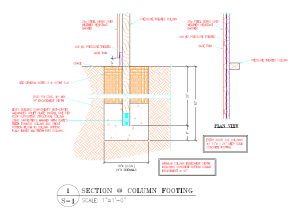 DEAR BRIAN: Hopefully your “laminated” posts will be true glulaminated columns and not 2×6 nailed together. In order to determine footing diameters, our engineers would need to know: Soil bearing capacity at your particular site (a Geotechnical Engineer should be engaged to provide an engineered soils report); Frost depth (soil bearing capacity has an allowable increase with depth of embedment); Sloped roof snow load (Ps). This is calculated from Ground Snow Load (Pg) and can vary due to roofing materials, roof slope, is building heated or not, use of building (True agricultural buildings have a 20% reduction to Ps); Roof dead loads – roofing materials and substrates (OSB or plywood), ceiling materials, as well as roof insulation.
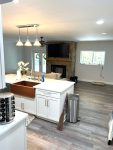 DEAR POLE BARN GURU: With my kit and installation does this mean move in ready? MARK in CANTON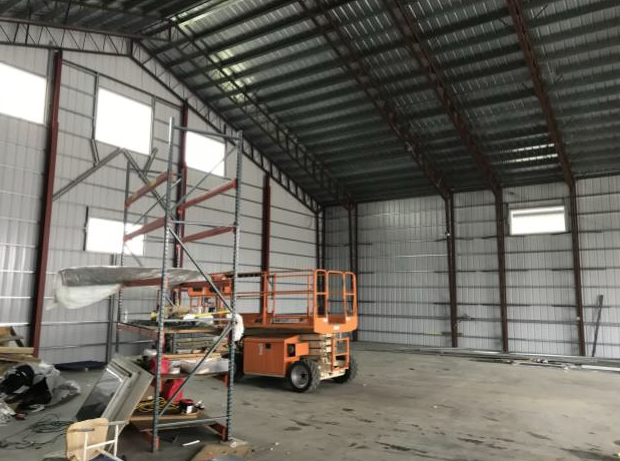
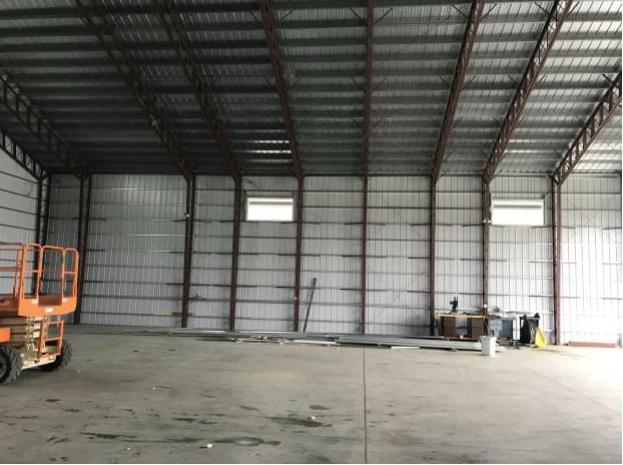
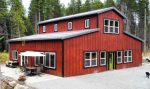 DEAR POLE BARN GURU: Hello. Looking to build a barndo home in north Georgia. I’m looking for financing the structure. Do you guys offer financing at Hansen? If so, does this include the concrete pad/foundation? Thank you for your time! BRIANNA in DALTON
  DEAR POLE BARN GURU: Have a 40×60 barn trusses have 2×8 top and bottom chord set on 10 ft centers live I deep so Illinois. Question is how is best way to frame in ceiling to put up metal might put small amount of cellulose blown it do not care which direction metal runs. Thanks in advance ROBERT in VIENNA
  DEAR POLE BARN GURU: We need a 20 x 40x 10 pavilion for a Scout Camp in Clay County Florida. If that is something your company can do, could you please send me a quote? Thank you. ROB in ST. AUGUSTINE
  DEAR POLE BARN GURU: Hello! What are your options for financing? I am a veteran planning to use a VA construction loan for purchasing a plot and initially constructing a modest tiny house, then, upon completing my grad degree in 2-3 years adding a four car garage and a horse barn. My initial budget is $300k for making this happen (land, VA approved construction parameters.) It’ll most likely be in Maryland or a reasonable commuting distance from Ft. Meade possibly PA or DE. Thanks. CHARLOTTE in LUTHERVILLE
  DEAR POLE BARN GURU: How much acreage is needed to build a pole barn in Madison County, IL? BONNIE in ALTON
  DEAR POLE BARN GURU: I’m looking to build a 25′ x 50′ pole barn 16 ft with an open lean-to on each side. I’d like the lean-to’s to be 20′ wide and the same depth (50′).so the total width would be 65′ by 50′ deep. My question is about financing. I’m not sure how financing would work. Do you have a financing co. or if that something I would get on my side? Thanks SHANE in BRIDGETON
 DEAR CHRIS: If you are insulating directly above bottom of trusses, then you need to ventilate this dead attic space. You could use rectangular gable vents spaced along each sidewall and have a vented ridge.
 DEAR BRONSON: Thank you for your interest in a new Hansen Pole Building.
 DEAR PETER: Unless your building has a very wide clearspan, or some huge dead loads (or perhaps a bonus room) a three ply truss seems strangely unusual. You might want to reach out to other possible truss manufacturers to see if you can get a two ply design. While I have seen three ply trusses notched in 4-1/2 inches approved by engineers, if indeed this is your final truss design solution, you should confirm connection adequacy by reaching out to your building’s Engineer of Record.