Tag Archives: frost line

Remediating Pole Barn Sliding Door Frost Heaves

Remediating Pole Barn Sliding Door Frost Heaves

Reader MARK in MARINE ON ST. CROIX writes:

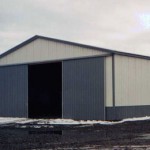
Pole Barn Warehouse“Poll barn door two 12 foot slider’s how to prevent frost heave s can’t open or close do I dig out under them and pour concrete or put 2 inch styrofoam any ideas?”

Harris Hyman, P.E. wrote this in a July 1994 article in Practical Engineering:

“As an engineer, I want to understand a little about the problem before I recommend corrective measures. Research work on frost heaving is somewhat limited, but there is a theory. Around the end of winter in cold regions, the earth develops a characteristic temperature profile: At the surface, the earth takes on the day’s temperature. But a couple of inches below, the ground temperature cools to approximately the February average temperature of the region. As we go deeper into the earth, the temperature rises, until several feet deep it reaches the annual mean temperature of the area.

The soil usually reaches its coldest temperature in March, when the freezing point reaches down to the region’s frost line. Below this depth, the soil and groundwater almost never freeze. But at the frost line — the 32°F point — the groundwater freezes, forming a thin sheet of ice. In soils that are porous enough to allow moisture to move, more groundwater touches this ice. The groundwater accumulates, freezes, and builds up into a bulge called an ice lens, which might be anywhere from several inches to a few feet across. The bulging ice lens pushes the earth above up into a frost heave. Aggravating the effect is surface melting, which also occurs at the end of March. The snow melt water moves through the ground, touches the ice lens, and adds to the bulge.

This is why, every spring, rural roads up North develop sinuous dips and dives. The ice lenses form during the winter, pushing up spots on the asphalt surface. When the weather warms sufficiently to melt the ice lenses, the unsupported asphalt sags and leaves low spots and potholes. On major highways, which cost a lot more to build, the base layer is sufficiently permeable to carry away groundwater, so heaves are rare.

Ice is fierce stuff. While most substances expand as they become warmer, ice actually expands as it gets colder, with the maximum expansion at about 28°F. When ice is confined, it can exert pressures from 20,000 to 80,000 pounds per square foot. There is almost no way to contain pressures like this; other solutions must be found.

The theory about ice lenses corresponds pretty well with the experience of engineers and excavating contractors. The most interesting implication is that heaving needs two things: cold and water.

This fact gives us our solution: Remove the water. Drainage is the one solution to heaving that does work most of the time.”

I would start by getting rid of any water. Slope ground away from building by at least 5% for 10 feet. Gutter downspouts need to discharge at least 10 feet away from building. Consider a French drainage system.

If this does not solve your issues, you could excavate to below frost line (I have had frost over seven feet deep not far away from you in Northeast South Dakota) and pour a concrete wall across your opening. If wall was thicker at base than top would also help minimize heave potential. Or, you could attempt to solve by pouring a concrete wall say 30″ deep, then insulate each side of wall down two feet and then out horizontally two to four feet with R-10 or thicker rigid insulation boards. Why both sides? I am assuming your pole barn does not have a concrete slab on grade and is unheated.

Will My Minnesota Shouse Require Frost Footings?

Will My Minnesota Shouse Require Frost Footings?

Reader CHAD in JANESVILLE writes:

“I am planning on building a shouse or barndominium some may call. I am doing 5″ cement with a heated floor throughout. My hope was not to bury any poles but to anchor them on top of the slap. Do you recommend front footings or will I be same as long as I am heated?”

My lovely bride and I happen to live in a post frame shouse just four hours West of you (and you are welcome to come for a visit)! In our instance, we used embedded columns, as I fully believe they will outlive my grandchildren’s grandchildren (for reading on lifespan of properly pressure preservative treated wood https://www.hansenpolebuildings.com/2020/09/pressure-treated-post-frame-building-poles-rot/).

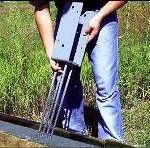
Now we do have a fair number of clients using wet set brackets, keeping their building columns above ground (https://www.hansenpolebuildings.com/2019/05/sturdi-wall-plus-concrete-brackets/).

These brackets need to be either placed into a continuous footing and foundation system, a thickened edge slab on grade or concrete piers. Any of these should extend below frost line, unless provisions are made to thermally isolate them from effects of frost.

The U.S. Department of Housing and Urban Development Office of Policy Development and Research has been so kind as to publish a plethora of information on Frost-Protected Shallow Foundations, (while not specific to post frame construction) would apply to any structural building system. Heat transfer truly doesn’t care how you put a structure together, just so long as thermal resistance issues are taken care of adequately.

Those who are considering Frost-Protected Shallow Foundations should peruse this information: https://www.huduser.gov/publications/pdf/fpsfguide.pdf, and utilize it to determine requirements for insulation R values, as well as depth vertical insulation boards should be placed and width of horizontal insulation extending out from your building.

Whatever your choice is, you should have structural plans sealed by a Registered Professional Engineer to verify system adequacy.

Post Frame on a Rock Pile

Post Frame on a Rock Pile?

Reader MIKE in MAINE writes:

“Hello ,

I am looking to purchase a Post and Beam Barn kit, but I have been advised by my excavator guy that I won’t be able to set the sonotubes in the ground due to the mixture of rocks sizes at my location

A bit of background:

The location is northern Maine and the soil composition is granite and clay, with poor drainage. Freezing line is probably at 8+ ft

The location chosen is a 75×75 area that has a pile of rocks collected from all over the old field years ago, and the suggested plan by the excavator guy was to grade that over a 75×75, add crushed gravel on top (10 inches or so) and when I told him I would need the sonotubes embedded at least 4-5ft down, he said I wouldn’t be able to dig the holes, but I won’t have any problems with heaving

This is an incorporated township, so there is no code requirement or enforcements (just as a fyi), but I still want to do things by the book for my own safety and investment protection

He suggested a perimeter sidewall of 12×12 and attach the posts to the wall with the perma column type brackets

My plan is to build at minimum a 40×50, ideally a 50×60 barn with porch around

I’ve uploaded a video of the site (as well as an alternative spot just across the road from it) and some still photos to help you help me divide what type of foundation do I need, and if it is in fact viable or doable

I would greatly appreciate your assistance with this before I commit tens of thousands of dollars into a kit I would not be able to build

Site video:

https://www.youtube.com/watch?v=FCUO6jBIWvE

Mike the Pole Barn Guru writes:

Thank you for your interest in a new Hansen Pole Building, as well as for providing so much valuable information.

Your rock pile site would be far less than ideal for several reasons, beyond just an inability to auger holes through rocks. Biggest challenge would be this being a terrible surface to pour a concrete slab on top of. Adding crushed rock over this is going to leave temporary voids between those larger, underlying stones. Over time crushed rock will slowly filter into these spaces, now your gaps will be directly below your slab – forcing your slab to bridge across them. Without significant amounts of rebar being added, slabs are not going to perform well under this scenario. Be prepared for more than just minimal cracking.

Any uninsulated foundation not extending to below frostline is likely to present frost heave issues over time.

My vote would be to opt for your alternative site. I have previously penned a four-part series on site preparation starting here: https://www.hansenpolebuildings.com/2011/11/site-preparation/

You have several options for foundation:

My favorite (also most cost effective and easiest to construct) – embedded columns. You can limit needed embedment depth to 40″ below grade by use of R-10 EPS insulation, going down two feet, then out another two feet.

Second choice would be using concrete piers with wet set brackets. Square piers can be formed out of EPS insulation (again to limit needed depths) with continuous insulation between piers. Sonotubes could be used, however they are difficult to effectively insulate, so it would be recommended to embed them to frost depth.

Please do not hesitate to reach out to me at any time with questions or concerns.
Will My Minnesota Shouse Require Frost Footings?

Will My Minnesota Shouse Require Frost Footings?

Reader CHAD in JANESVILLE writes:

“I am planning on building a shouse or barndominium some may call. I am doing 5″ cement with a heated floor throughout. My hope was not to bury any poles but to anchor them on top of the slap. Do you recommend front footings or will I be same as long as I am heated?”

My lovely bride and I happen to live in a post frame shouse just four hours West of you (and you are welcome to come for a visit)! In our instance, we used embedded columns, as I fully believe they will outlive my grandchildren’s grandchildren (for reading on lifespan of properly pressure preservative treated wood https://www.hansenpolebuildings.com/2020/09/pressure-treated-post-frame-building-poles-rot/).

Now we do have a fair number of clients using wet set brackets, keeping their building columns above ground (https://www.hansenpolebuildings.com/2019/05/sturdi-wall-plus-concrete-brackets/).
These brackets need to be either placed into a continuous footing and foundation system, a thickened edge slab on grade or concrete piers. Any of these should extend below frost line, unless provisions are made to thermally isolate them from effects of frost.

The U.S. Department of Housing and Urban Development Office of Policy Development and Research has been so kind as to publish a plethora of information on Frost-Protected Shallow Foundations, (while not specific to post frame construction) would apply to any structural building system. Heat transfer truly doesn’t care how you put a structure together, just so long as thermal resistance issues are taken care of adequately.

Those who are considering Frost-Protected Shallow Foundations should peruse this information: https://www.huduser.gov/publications/pdf/fpsfguide.pdf, and utilize it to determine requirements for insulation R values, as well as depth vertical insulation boards should be placed and width of horizontal insulation extending out from your building.

Whatever your choice is, you should have structural plans sealed by a Registered Professional Engineer to verify system adequacy.