Tag Archives: pole barn ceiling insulation

Ceiling Insulation, Wiring for Bookshelf Girts, and Setting Trusses

This Wednesday readers “Ask the Guru” how to insulate a post frame ceiling that already has bubble wrap, how to wire for bookshelf girts, and how to set trusses where a crane is not an option.

DEAR POLE BARN GURU: Best and easiest way to insulate the sloped ceiling in my pole building? it already has a single bubble wrap. see attached picture. I appreciate any help you can give thank you. BRIAN in LEXINGTON
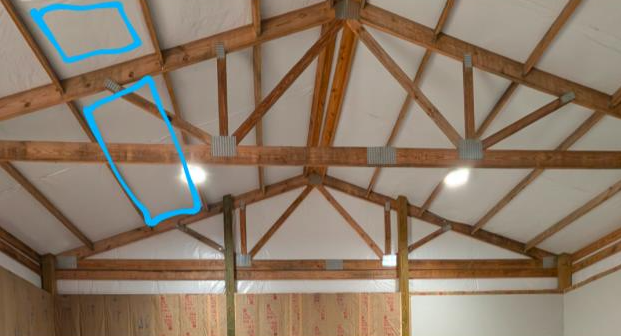
DEAR BRIAN: Rip out single bubble wrap between purlins and roof steel. Have closed cell spray foam applied directly to underside of roof steel. Those 2×4 roof purlins will allow for 3-1/2 inches, totally filling cavity. This will give you roughly R-24. You could then apply a light-weight flexible finish material to underside of purlins (something like steel liner panels). You may find it necessary to mechanically dehumidify building to prevent excess relative humidity.

Your building’s roof system is also missing some things. Roof purlins should be connected to truss top chords with joist hangers. Required 2×4 bottom chord bracing is also not present. There should be 2×4 no greater than 10 foot on center, running from endwall to endwall. This prevents out-of-plane buckling. Easiest application would be to use Simpson SDWS16300 screws to attach alongside endwall columns – then use joist hangers to attach to truss bottom Chords.


DEAR POLE BARN GURU: Post frame building with bookshelf girts. Siding attached to bookshelf girt and posts. Want to attach drywall to other side of post. How do I run wiring? I guess drill. How large of a hole can I drill through the support posts. Any other options? Thanks JOHN in POULSBO
DEAR JOHN: Very little drilling, if any, will be needed for holes in order to run electrical wires. Wall framing (girts) extend or are placed so as to leave a 1-1/2 inch space between outside of wall columns and siding.

Think of a hole being drilled through as being an “open knot”. Lumber grading rules refer to these as being “Unsound or Loose Knots and Holes” due to any cause.

For #2 graded lumber holes may be no less than every two feet and up to 5/8” diameter in a 2” nominal face; 7/8” in a 3” nominal face; 1-1/4” for 4”; 1-1/2” for 6”; 2” for 8” and 2-12” for 10”.

For higher grades holes may be no less than every three feet and up to ½” diameter in a 2” nominal face; ¾” in a 3” nominal face; 1” for 4”; 1-1/4” for 6” and 1-1/2” for 8” and wider.

Any holes drilled through pressure preservative treated lumber or columns, especially near grade, should be treated with a Copper Naphthenate solution. Copper Naphthenate is available as a brush-on or spray-on.


DEAR POLE BARN GURU: Hello,

We are trying to identify our options for setting 7 trusses in a space inaccessible for a crane or equipment that could use a hoist of any sort.

We’d like to estimate the weight of each truss while we wait on quotes.

The span is 16′ + 1′ overhang each side, 6/12 pitch, designed for 4′ centers spacing and carry total load (including our snow load) of 90 lbs.

We hoped to prop up 1 end on the top girder, or beam, then carry up the other end on a ladder to the beam on that end. Then hope to “flip” or rotate the apex upright with a 2×4.

Is there an easier way, given only about 4 people to do this & only 1 of the 4 is a brute?!

We are in Upper Peninsula of Michigan, snow load requirements of 90lbs.

Steel roofing, no ceiling ever- just a tractor barn/wood shed.

Thank you! KAREN in MICHIGAN
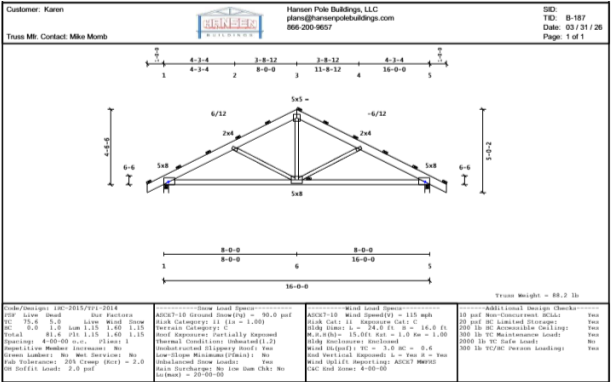
DEAR KAREN: They should weigh just under 90 pounds each. Your described flipping them up, should work well.

Insulation in Massachusetts, Code Restrictions in MN, and Insulation for In-Floor Heated Building

This Wednesday the Pole barn Guru answers reader questions about the best options for insulating a 24×30 pole barn, potential code restrictions in Victoria, MN, and Insulating a building with radiant floor heating.

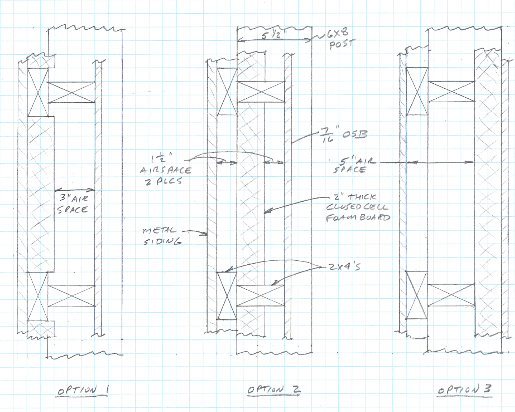
DEAR POLE BARN GURU: Hello, I want to insulate my 24’x30′ pole barn located in Massachusetts. I will heat it only occasionally. I have decided due to budget and other considerations to use 2″ thick closed-cell foam in the walls. I am unsure whether to piece the foam between the bookshelf girts and place it up against the steel siding, or on the inside of the flatwise girt, leaving a 1 1/2″ gap between the foam and siding. In either case I will be sure to seal all the joints well with spray foam. I’m thinking the second option would be better to avoid trapping moisture between the foam and siding. I suppose a third option would be to install the foam on the inside of the bookshelf girts leaving a 5″ air space. This option has the benefit of eliminating the thermal break created by the girts. Which option do you recommend? DAVID in WESTFIELD

Just when you think you have everything figured out, along comes me and picks Door D.

What? There is no Door D….

Air gaps in walls are problematic, they allow moisture to gather, drafts to occur and fire to rapidly spread.

My recommendation is to completely fill this cavity with Rockwool. It does not burn, is not affected by moisture and critters will not try to live or nest in it. You will want to have a vapor barrier on interior face, between framing and wall finish.

For extended reading: https://www.hansenpolebuildings.com/2013/03/roxul-insulation/


DEAR POLE BARN GURU: I live on an acre within the city limits of Victoria, MN does the code allow pole barns as a detached garage? MARK in VICTORIA
DEAR MARK: A permit issuing jurisdiction cannot legally restrict a code conforming structural system, however your Planning Department may have restrictions in regards to setbacks, footprint and even allowable types of roofing and/or siding. You will want to reach out them directly: https://victoriamn.gov/government/community___economic_development/index.php (contacts and phone numbers are at left side of page).

This should prove helpful further reading: https://www.hansenpolebuildings.com/2013/01/planning-department-3/


DEAR POLE BARN GURU: What Options other than spray foam for insulating a pole barn ceiling up against the roof peak to keep the trusses exposed? Building has Prefabricated wood 2×6 trusses 4′ apart with wood 2×4 purlins against the metal roof. Building has no vaper barrier. Planning on doing 2 layers of insulation on the walls. First layer 2″ Foil faced EPS foam board against the girts (not between the girts) with taped seams. Second layer 3 1/2″ mineral wool. The 2 layers will fill the 5 1/2″ cavity between the 4×6 posts. Should the walls have a plastic vaper barrier on the inside after the mineral wool? Or is the first layer of EPS foam board act as a vaper barrier? Building will have radiant floor heating. I Appreciate your thoughts, Thanks! PETER in MANAHAWKIN

DEAR PETER: You have no option but closed cell spray foam applied directly to underside of roof steel, if you want to leave trusses exposed. Otherwise, you would have to provide an inch of clear airflow from eave to ridge directly below roof deck – impossible with purlins blocking this flow. A better option would be to install a ceiling (provided your trusses will support this added weight) and blow in granulated Rockwool or fiberglass (this does require vented eaves and ridge in correct proportions). Why better? You will not be heating a huge volume of space above your truss bottom chords. You should, however, still spray enough closed cell spray foam on underside of roof deck to prevent condensation (2 should do it).

Your sealed foam boards are now your vapor barrier, so you will want no interior vapor barrier. This combination, along with spray foamed roof deck, will cause your building to ‘dry’ to inside. Expect to have to mechanically dehumidify, or face mold and mildew issues.

How to Get Pole Building Financing

Welcome to Ask the Pole Barn Guru – where you can ask questions about building topics, with answers posted on Mondays.  With many questions to answer, please be patient to watch for yours to come up on a future Monday segment.  If you want a quick answer, please be sure to answer with a “reply-able” email address.

Email all questions to: PoleBarnGuru@HansenPoleBuildings.com

 DEAR POLE BARN GURU: Good afternoon: If I were to purchase a pole barn through your company would I get pole building financing through you? Or would I get a loan through a local bank? Please advise

Thank you for your help MARINA

DEAR MARINA: Thank you very much for your interest. You can actually do either one. For options on pole building financing through our sources: https://www.hansenpolebuildings.com/financing/

Mike the Pole Barn Guru

DEAR POLE BARN GURU: I would like to know if y’all had some kind of payment plan or if I had to pay the whole cost of a new garage up front? MATT

DEAR MATT: Thank you very much for your interest in a new Hansen Pole Building. It is not necessary to pay for the whole cost of your new building up front. We have numerous pole building financing plans available, depending upon your credit worthiness. Please visit https://www.hansenpolebuildings.com/financing/ to apply.

Mike the Pole Barn Guru

DEAR POLE BARN GURU: Good Morning, I am hoping to get more information on building a small, single story storage shed sized at 10’ x 40’. If you could send me any spec information about the building materials or any other information pertaining to building a storage shed that size, that would be great. Thank you, DIANA

DEAR DIANA: Thank you very much for your interest in a new Hansen Pole Building. We have a plethora of information available on our website. A good starting point would be to download our Product Guide: https://www.hansenpolebuildings.com/product-guide/ and to sign up for our newsletters: https://www.hansenpolebuildings.com/pole-building-newsletter/

As you beginning seriously planning your new pole building, this will be helpful to you: https://www.hansenpolebuildings.com/pole-barn-planning-guide.

All Hansen Buildings are custom designed, so whenever you are prepared to begin formulating a budget, feel free to request a quote at: https://www.hansenpolebuildings.com/freequote/

where one of the Hansen Buildings’ Designers can assist you towards the building of your dreams.

Mike the Pole Barn Guru

DEAR POLE BARN GURU: I have a 24’x40’x16′ pole barn that has the bubble wrap insulation. But it doesn’t provide much during the winters. What can I put on the walls and ceiling to keep it warmer in the barn? Spray foam cost way too much? JASON IN HENRYVILLE

DEAR JASON: Reflective insulation (aka “bubble wrap”) is a great product when utilized for what it is best as – a thermal break to prevent condensation issues on the inside of steel roofing and siding.

If you have a product with reflective aluminum facing on the exterior – it will also aid against heat gain. What it is NOT going to do is afford much resistance to heat loss.

The majority of heat loss is up – and where to make the investment first, if on a tight budget. Most pole barn trusses are not designed to support the weight of a ceiling, so we will work with this as an assumption. To add the least amount of weight – attach light weight material which is NOT a vapor barrier (I see chicken wire used frequently) tightly across the bottom chords of the trusses. Unfaced fiberglass blanket insulation can be placed on top of this, between the truss bottom chords. It is available in eight foot wide rolls, which works nicely if your building has trusses spaced eight foot on center.

For your area, a minimum of R-38 would be a starting point. This does create a dead attic space which must be ventilated.

If you do not already have vented eaves and ridge, the only solution is gable vents. https://www.hansenpolebuildings.com/blog/2014/02/pole-building-ventilation/

If your building has sliding doors – climate control will be a perpetual challenge, no matter what you do, they are going to suck out most of any type of heat you try to add. If possible, replace them with insulated overhead doors. https://www.hansenpolebuildings.com/blog/2012/04/climate-control/

Walls can be insulated with the same un-faced insulation which was used in the ceiling (if posts are eight foot on center). Holes will need to be made in the wall reflective insulation, so as not to create a cavity with insulation trapped between two vapor barriers. Attach the insulation to framing at the top of the walls and drape it down between the columns. A vapor barrier needs to be placed on the inside of the insulation and then cover the vapor barrier with gypsum wallboard, plywood, OSB, etc. (all of which will require additional framing to be added).

While it is too late for you – the easiest way to solve these challenges is to prevent them in the beginning by proper design up front. Read how here: https://www.hansenpolebuildings.com/blog/2012/04/climate-controlled/