This Wednesday readers “Ask the Guru” how to insulate a post frame ceiling that already has bubble wrap, how to wire for bookshelf girts, and how to set trusses where a crane is not an option.
DEAR POLE BARN GURU: Best and easiest way to insulate the sloped ceiling in my pole building? it already has a single bubble wrap. see attached picture. I appreciate any help you can give thank you. BRIAN in LEXINGTON
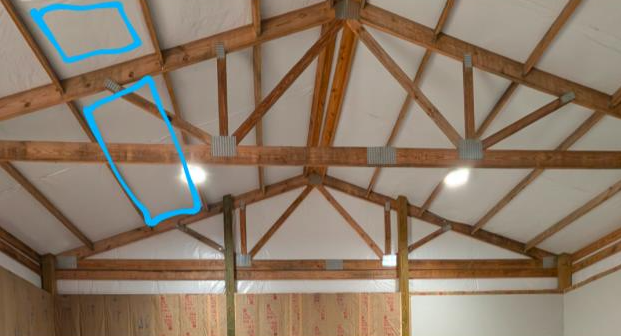
DEAR BRIAN: Rip out single bubble wrap between purlins and roof steel. Have closed cell spray foam applied directly to underside of roof steel. Those 2×4 roof purlins will allow for 3-1/2 inches, totally filling cavity. This will give you roughly R-24. You could then apply a light-weight flexible finish material to underside of purlins (something like steel liner panels). You may find it necessary to mechanically dehumidify building to prevent excess relative humidity.
Your building’s roof system is also missing some things. Roof purlins should be connected to truss top chords with joist hangers. Required 2×4 bottom chord bracing is also not present. There should be 2×4 no greater than 10 foot on center, running from endwall to endwall. This prevents out-of-plane buckling. Easiest application would be to use Simpson SDWS16300 screws to attach alongside endwall columns – then use joist hangers to attach to truss bottom Chords.
DEAR POLE BARN GURU: Post frame building with bookshelf girts. Siding attached to bookshelf girt and posts. Want to attach drywall to other side of post. How do I run wiring? I guess drill. How large of a hole can I drill through the support posts. Any other options? Thanks JOHN in POULSBO
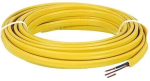 DEAR JOHN: Very little drilling, if any, will be needed for holes in order to run electrical wires. Wall framing (girts) extend or are placed so as to leave a 1-1/2 inch space between outside of wall columns and siding.
Think of a hole being drilled through as being an “open knot”. Lumber grading rules refer to these as being “Unsound or Loose Knots and Holes” due to any cause.
For #2 graded lumber holes may be no less than every two feet and up to 5/8” diameter in a 2” nominal face; 7/8” in a 3” nominal face; 1-1/4” for 4”; 1-1/2” for 6”; 2” for 8” and 2-12” for 10”.
For higher grades holes may be no less than every three feet and up to ½” diameter in a 2” nominal face; ¾” in a 3” nominal face; 1” for 4”; 1-1/4” for 6” and 1-1/2” for 8” and wider.
Any holes drilled through pressure preservative treated lumber or columns, especially near grade, should be treated with a Copper Naphthenate solution. Copper Naphthenate is available as a brush-on or spray-on.
DEAR POLE BARN GURU: Hello,
We are trying to identify our options for setting 7 trusses in a space inaccessible for a crane or equipment that could use a hoist of any sort.
We’d like to estimate the weight of each truss while we wait on quotes.
The span is 16′ + 1′ overhang each side, 6/12 pitch, designed for 4′ centers spacing and carry total load (including our snow load) of 90 lbs.
We hoped to prop up 1 end on the top girder, or beam, then carry up the other end on a ladder to the beam on that end. Then hope to “flip” or rotate the apex upright with a 2×4.
Is there an easier way, given only about 4 people to do this & only 1 of the 4 is a brute?!
We are in Upper Peninsula of Michigan, snow load requirements of 90lbs.
Steel roofing, no ceiling ever- just a tractor barn/wood shed.
Thank you! KAREN in MICHIGAN
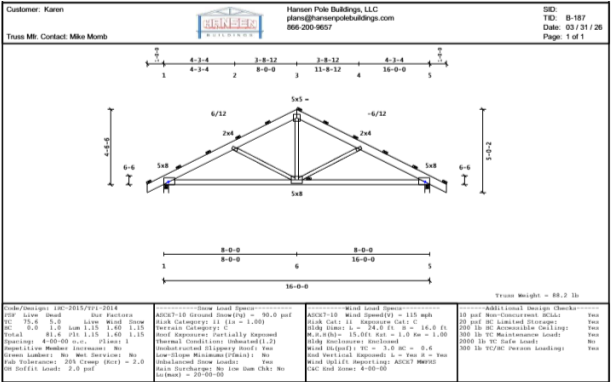
DEAR KAREN: They should weigh just under 90 pounds each. Your described flipping them up, should work well.
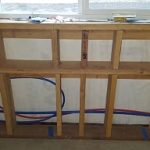 DEAR SCOTT: Very little drilling, if any, will be needed for holes in order to run electrical wires. Wall framing (girts) extend or are placed so as to leave a 1-1/2 inch space between outside of wall columns and siding.
 DEAR POLE BARN GURU: Can you build on a poured concrete walls for a basement? ZAC in LEIPSIC
  DEAR VAL: Allowable distance between buildings will depend upon how your property is zoned and use classification of your buildings. In most jurisdictions, a residence to a garage (as an example) can be as little as five feet, without requiring added fire protection between them. If you are outside of Oak Harbor Village limits in Ottawa County, a call to your Building Department at 419.734.6767, in the Village of Oak Harbor call Zoning at 419.898.5561. Have your street address and parcel number available.