This week’s Ask the Guru answers reader questions about insulating a open bay with no ceiling, use of a vapor barrier on steel ceiling with blown in insulation, and a question about what gauge metal we use at Hansen Pole Buildings.
 DEAR POLE BARN GURU: I built one of your barns (project 24-0503F). It’s 36 x 48, so has 4, 12′ bays. 3 of the bays will have a ceiling, so the ceiling will be insulated. The remaining bay will remain open with no ceiling. How do I insulate the roof of the open bay? It has 2×6 purlins on edge. As the purlins run parallel to the soffit vent, they block off air flow from the soffit to ridge vent. Does this air flow need to be maintained, or just insulate the purlin bays and finish off the underside of the purlins? Thanks in advance. TROY in HONEOYE FALLS
DEAR TROY: Thank you for your investment, much appreciated! We would enjoy seeing photos of your build – both during construction and completed.
You have a couple of things going on here –
First, your roof purlins are not designed to support a directly applied finish. While this is not likely to cause a failure (if material is attached to underside of them), there is a distinct possibility you will have overly great deflection. This could prove to be noticeable on building exterior and if a rigid material such as sheetrock is used, anticipate cracking of joints.
Secondly, when insulating with batts between purlins it is essential to maintain at least an inch of clear airflow from eave vents to ridge vent directly above insulation. I would normally then recommend using closed cell spray foam applied directly to underside of roof steel, except your roof steel has a factory applied Integral Condensation Control, making it likely closed cell spray foam will not adequately adhere.
What to do? My best recommendation would be to finish off ceiling of all four bays and insulate directly above finished ceiling.
DEAR POLE BARN GURU: I have a pole barn/garage that I want to finish on the inside. I will not be heating it on a regular basis (at this time), but that could change in the future. I live in central Ohio and I’m pretty sure we have less than 8000 degree days (per one of your posts). My building has a shingle roof and vinyl siding. I want to install a metal ceiling with approximately 10 inches of fiberglass insulation. Two questions: 1. Do I need a vapor barrier between the metal ceiling and insulation? 2. Do I need a vapor barrier on the side walls between the OSB and insulation? TOM in PLAIN CITY
 DEAR TOM: Indeed, where you are there are less than 8000 degree days.
You do not need a vapor barrier between your ceiling steel liner panels and fiberglass insulation above. You do need to make certain you have adequate ventilation with unobstructed airflow from eave to ridge.
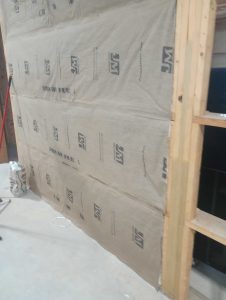
For walls, you will need a vapor retarder on inside (warm-in-winter) face of batt insulation. If using faced fiberglass, Kraft facing is a Class II vapor retarder. The asphalt on Kraft paper has a perm rating of about 1.0. This allows some moisture to pass through, helping prevent it from getting trapped inside and causing mold or rot. I would recommend using unfaced Rockwool batts, with an interior clear poly vapor barrier. Vapor barriers completely stop passage of water vapor and have a very low perm rating (typically below 0.1). Rockwool is preferred, as it is not affected by moisture.
 DEAR POLE BARN GURU: What gauge metal do you use? JIM in AMSTERDAM
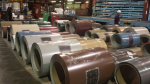
DEAR JIM: Most popular for through screwed siding and roofing panels is 29 gauge. We also offer these same panels as 26 gauge.
Here is a bit of interesting reading on steel gauges: https://www.hansenpolebuildings.com/2020/11/do-barndominiums-need-29-gauge-steel/
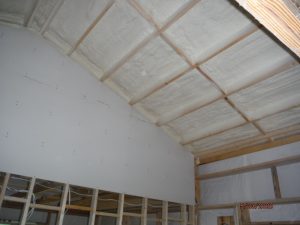 Lake Charles is in climate zone 2A. 2018’s International Energy Conservation Code prescriptively mandates (for your zone) a minimum R-38 value for ceilings and R-13 for wood framed walls. This would require 5-1/2″ in roof and 2″ in walls. You could go with 2″ of closed cell directly to underside of roof deck plus 6″ of open cell, or 2-1/4″ of closed cell with 5-1/2″ of Rockwool as alternatives.