Tag Archives: post frame condensation

Moisture Buildup in Post Frame Walls

Moisture Buildup in Post Frame Walls

Reader TOM in MONTROSE writes:

“Hi, In the summer of 2025 I build a post frame building (40x72x16) located in MN, 8ft o.c. (on center) post spacing, trusses 4ft o.c. w/14 inch heal height, 24 inch overhangs (plenty of ventilation for the attic). I then placed vertical 2×6 studs 2ft o.c. in-between the posts. I put a house wrap on the outside and covered it with steel. I placed 6mil plastic on the ceiling and lined it with steel. I proceeded to blow in 13 inches of fiberglass insulation. At this point I feel good about the attic. I then installed R19 faced insulation in-between the studs and stapled it to the inside of the studs. I ran OSB half way up the walls, the top half will be steel (not done yet). Had a tube heater installed and it has been running since mid-December! Can you in vision the problem I’m having behind the insulation in the walls with this COLD weather? Moisture build up and I’m planning my attack for correcting this issue this coming spring/summer. I need your advice pole barn Guru about my plan….My plan is to: remove the OSB, remove the faced batt insulation, air/dry the walls out and the insulation. I’m going the remove the paper from the batts and just have unfaced batt insulation. Before I place the batts back into position between the studs, I’m going to nail up an 8 inch wide x 1/4 inch OSB strip running the full length from top to bottom in each stud bay. My thinking behind this is to prevent the insulation from touching/resting on the house wrap as it is currently. And also to provide an air space for any future moisture to dry out. I am than going to place 6 mil poly over the insulation, re-attach my lower OSB and steel the top half. And hope that I never have this moisture problem again!!! Your thoughts Guru? Thank you in advance for your help!!!”

My biggest concern is to determine where moisture is coming from, then eliminate it.
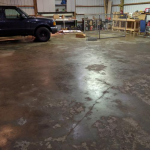
Best guess is it is coming from your concrete slab – either moisture from it being poured has not fully exited or (and more likely) there is not an adequate vapor barrier under it.

If your slab does not have a vapor barrier underneath – use a good sealant on top of it. Slope finished grade away from building at least 5% for no less than 10 feet. Gutter downspouts need to discharge at least 10 feet away from building. It may be necessary to install a french drain to move underground water away from your building.

Tear out fiberglass wall insulation and throw it away. Once completely saturated it must be replaced to prevent mold, reduced efficiency and/or structural damage. Replace with rockwool insulation with a well-sealed interior vapor barrier. Wall insulation should be in direct contact with your house wrap. This prevents air gaps within wall cavity, improving overall energy efficiency and reducing convective heat loss.

If your house wrap is not breathable, or is installed with printed side in, rather than out – it needs to be removed and replaced.

Once you have cured where moisture is coming from, you should be good forever.

Make sure attic is properly ventilated with soffit vents at eaves and a ridge vent. These need to be properly proportioned to achieve correct amount of air intake and exhaust. There needs to be no less than an inch of clear airflow above attic insulation from eave to ridge. 13 inches of attic insulation would not be considered adequate for our climate, it should be no less than R-60.

A Case for Minimum Post Frame Truss Loads

A Case for Minimum Post Frame Truss Loads

Portions of this article were written specifically for Component Advertiser, a monthly truss industry publication. However I feel strongly enough about this subject to use my column to pitch it to both my employers and other post frame building kit suppliers and contractors.

In my career I have done about everything imaginable when it comes to post frame (pole) building trusses. I have been blessed to have been able to spend a better portion of over two decades working within or owning prefabricated MPCWT (metal plate connected wood trusses) manufacturing facilities. I have designed, engineered, fabricated and delivered trusses. As a builder, I raised my first set of post frame trusses nearly 40 years ago and many more have followed.

I have also been a provider of post frame building kit packages across most of my adult life. Our industry (post frame buildings) is one where low price, rather than service and quality, drives most sellers and buyers. Sellers, more often than not, have not learned well how to convey value of benefits they offer – instead they live in fear of being a five-spot more than their competitors when it comes to price.

For nearly seven years I have been writing a weekly advice column, “Ask the Pole Barn Guru™”, where I answer post frame building oriented questions from anyone. One repeatedly asked question is in regards to adding ceilings to existing post frame buildings. Most roof trusses for these buildings were not designed to support ceiling loads, generally due to a fear of increasing building price.

Many post frame buildings are constructed in areas where pole buildings are exempt from building permits, or there are little or no structural plans reviews done. This contributes to an attitude of “make it cheap” by encouraging use of minimal loads for trusses.

A great majority of post frame buildings are used as residential accessory buildings – garages, shops, RV parking, man caves, she sheds, etc. Nearly all of these buildings have truss spans of 40 feet or less, so my proposal for voluntary minimum loading requirements for post frame buildings will be directed towards these structures.

Why not apply these minimums to larger span structures? Many wider span buildings are going to be used as horse riding arenas or equipment storage for farming and are never going to have ceilings in them. Costs to design for greater loads, for spans of 50 feet and greater could result in some significant costs. Wide span buildings being used for more humanly occupied (and therefore more critical in protection of human life) purposes are likely to have a Registered Design Professional (architect or engineer) involved, who will specify roof loads based upon building use and function.

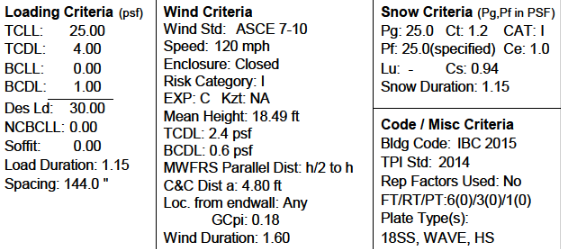
In areas of minimal or no snow, with Pg (ground snow load) values of under 20 psf (pounds per square foot) Top Chord Live Load (TCLL) should be fixed using a minimum of 20. For areas where white stuff has a greater possibility of occurrence 25 psf appears to be a reasonable minimum.

Most post frame buildings have light gauge steel roofing over purlins. Hopefully they also have some sort of minimal weight material between these to minimize or prevent condensation issues. In most instances, total dead loads required in order to support truss weight, condensation control, purlins and roofing will be less than 2.5 psf. There are folks who have ideas not always shared with truss designers – like using OSB or plywood sheathing between purlins and roofing. Also, rooftop solar panels are becoming more and more popular and find their way onto more than a few roofs not designed to support their weight.

My proposal (again for buildings of 40 foot spans and less) would be for a minimum TCDL (Top Chord Dead Load) of five psf. While this does not solve every possible case, it does allow for greater end user flexibility.

Traditionally, most post frame buildings did not have ceilings installed, so a very minimal BCDL (Bottom Chord Dead Load) has been used. Most typically a one psf loading will be selected, more than covering bottom chord lateral bracing and limited lighting. However, as post frame have moved from farms to suburbia, more buildings are getting interior finishes – meaning ceilings. I like to use 10 psf, in cases where I am designing for a drywall covered ceiling with insulation above, however even five psf would handle most ceiling loads.

Load duration – no snow, I am good with 1.25, snow areas 1.15. However, in my humble opinion, if TCLL exceeds 50 psf, chances are snow will be piled on top of these trusses for more than two months across structure’s lifetime and a DOL (Duration of Load) of 1.0 will be most appropriate.

A hidden side benefit to establishing these voluntary minimums will be stronger trusses able to withstand more abuse in handling. Some lumber members will be larger dimension or higher grade material and steel connector plates will increase in size. All of these factors increase probabilities of reduced truss damage.

Hansen VisionNow, I believe, time has come to stop selling price to post frame building clients and sell benefits. Safety becomes easiest to sell – no one wants to live with a fear of their building collapsing and injuring them, their loved ones, or destroying their valued possessions. Flexibility in future use – also an easy sell, if a future building owner decides they want to add a ceiling they can safely do so.
Minimum post frame truss loading benefits all, by raising the overall quality of finished buildings  with a negligible investment.

How to Properly Apply Post Frame Concrete Sealant

How to Properly Apply Post Frame Building Concrete Sealant

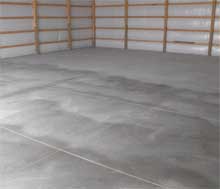
Condensation in post frame buildings can be problematic. In order to reduce condensation probabilities, minimizing water vapor sources proves to be paramount. Concrete slabs, especially if no vapor barrier was placed beneath them, are a prime source of water vapor. Proper application of sealant can greatly reduce or eliminate water vapor transmission from slab into the building.

Concrete sealant will make your concrete more resistant to weather exposure, water, grease and oil stains, abrasion and deicing salts. What’s more, they will help to make it easier to clean. But in order for a sealer to work its magic, it must be applied properly. Each step, from surface preparation to choosing right application method for product, will have a big impact on final outcome.

Following are some tips for applying concrete sealer properly. Whichever brand of sealant you use, be sure to follow specific instructions recommended by product manufacturer, since they may differ from general guidelines given here.

When you apply sealer can be important as well. Allow new concrete to cure completely (28 days or more, as recommended). Most sealers must be applied under dry conditions, since applying sealant to damp concrete could cause haziness or loss of adhesion. Air temperatures are also important and should typically be above 50°F during and for 24 hours or more after sealer application. Always allow sealer to dry completely before exposing it to foot or vehicle traffic. Drying times before exposure to heavy traffic can be as long as three days.


Surface preparation before applying a sealant will be extremely important. All oil, grease, stains, dirt, and dust must be removed or they may prevent sealer from adhering properly. Some manufacturers recommend etching surface first with an etching solution to ensure best adhesion.

Two most common methods of applying sealant to concrete surfaces are by roller or sprayer, often depending upon whether choosing a solvent or water based sealer. Always refer to manufacturer’s specific application guidelines.

Regardless of application method always strive for maximum coverage. Typical coverage rate should be 250 to 300 square feet per gallon, depending upon concrete porosity. Most important rule to remember – it’s best to apply two thin coats, making sure sealant doesn’t puddle or form uneven, thick areas. When applying a second coat of sealant, apply it in opposite direction (or perpendicular) to first coat to ensure even coverage. Wait to apply second coat of sealant for 24 hours or time recommended by the manufacturer.