This week the Pole Barn Guru tackles reader questions about a building set into a slope with use of post brackets, the possible use of “cross bracing” for wall girts, and understanding pressure treated wood.
DEAR POLE BARN GURU: I would like to build a 32′ x 48′ 2 story pole building where two of the sides of at least the lower floor are at least partially set into the hillside on the property. I envision the two sides set into the hill to be concrete foundation walls. Sort of a daylight basement. The lower floor would be a woodshop and the upper floor a two bedroom apartment. I am assuming a concrete foundation with Laminated “poles” mounted in brackets as opposed to buried. the “poles” on the two sides set into the hill would be shorter than on the other two sides. With the available space, the two story concept works better than having everything on a single story. Is this even possible? What would a ROM cost for a kit like that cost?
Thank you BILL in WEST RICHLAND
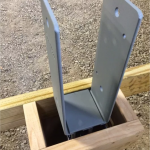 DEAR BILL: Your idea is totally possible. I have done it myself. In my case I had 12 feet of grade change across my building’s 40 foot width. I used ICFs full height on one sidewall and stepping down across rear endwall. Columns on these two walls were mounted using wet set brackets, other two walls had embedded columns. This process could also be used with poured concrete or block walls. We have also developed a system to use columns placed in a permanent wood foundation.
Attached photo is of my own building.
This is being shared with your Hansen Pole Buildings’ Designer who will be reaching out to you shortly.
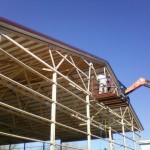 DEAR POLE BARN GURU: When using bookshelf girts is cross bracing used between posts or are the girts when blocked provide the support? WINSTON in MOULTON
DEAR WINSTON: No cross bracing is required when using bookshelf girts. Once installed (ideally blocked solid to columns at each end) and sheathing (OSB, plywood, structural panels or steel siding) is applied, your wall and girts are more than adequately supported and this assembly is fairly rigid.
DEAR POLE BARN GURU: I read the article regarding treated wood. I am still a little puzzled as to what treating you would use for ground contact purposes, especially the upright poles. Do you have any other articles regarding this subject or have input you could email me? Much appreciated, thank you. KELLY in VICTOR
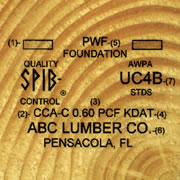 DEAR KELLY: Pressure preservative treated wood standards can be confusing even for lumber dealers, professional builders and building inspectors. For structural building columns, all end tags should have UC-4B marked on them. UC-4B is for “Heavy Duty” use. This American Wood Preservers Association infographic might prove helpful to understanding proper uses for pressure preservative treated wood: https://www.spib.org/uploads/pdfs/ResidentialInfographic2016.pdf
 DEAR POLE BARN GURU: I am seeking affordable housing but am unfamiliar with pole barns. Where should I start to educate myself? I have questions like 1) what is the process of building one? 2) legality of the unconventional home (I live in South Carolina) 3) is financing a pain because it’s not the norm 4) do you offer services beyond just the building, things like drive, septics, and so on. MITCHELL in LANCASTER
 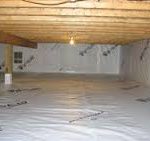 DEAR POLE BARN GURU: Is it possible to place a barndominium on a crawlspace? MICHAEL in GUSTON