Insulating and Sheeting Interior of a Pole Barn
STEVE in EDEN writes:
“We have four seasons with temps getting below freezing in the winter and up to 90 in the summer, with average humidity of 70% and 20%, respectively. I have a pole barn with metal skin. The ceiling or inside of roof is insulated with plastic coated insulation. The walls are not insulated. The 2×6 Girts were installed between the poles with their flat sides parallel to the floor. In other words, the 6 inch width of the board is horizontal or laid flat. I wish to insulate and sheet the interior of the barn. I anticipate heating the interior only when in use to about 50 degrees and may run a standing shop evaporative cooler or even AC in the summer during the hottest times to about 80 degrees. The structure is 32 x 50 x 14, has two insulated garage doors at one end, two man doors and two 4×2 windows. I’m on a budget. I plan to sheet the interior walls with 1/2 inch OSB. I have a few questions: 1. Should I use vapor barrier between insulation and OSB? Insulation contractor who lives down the street claims it’s unnecessary in our climate and given my use, but I wonder. I am going to paint the OSB. Perhaps that will act as a barrier? 2. The Girts are on about 32 inch horizontal centers. I plan to install the OSB board vertically, or rather on their ends, but am open to staking them horizontally. Any advice there?3. If I install vertically, should I frame in studs such that the vertical or long sides meet on a stud? I will run a base plate along the concrete floor, so the weight of the OSB sheeting will be supported on that plate. I’m just looking to cover the insulation. I’m not going to be hanging anything on the walls. I have metal, standalone shelves and cabinets for storage. I really appreciate your help here. I am DIY’er for sure. I have to do this stuff on my own.”
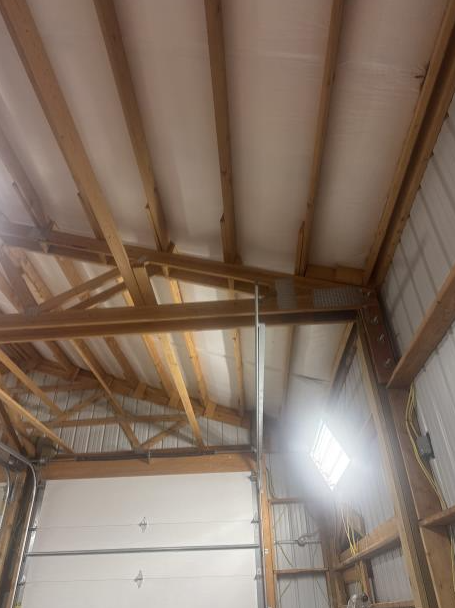
As roughly 3/4 of all heat loss is up, and you are on a budget, you may want to investigate adding a ceiling to underside of roof trusses first. Provided roof trusses are adequately designed to support a ceiling load, and adequate ventilation is provided for at eaves and ridge, this would allow fiberglass insulation to be blown in above ceiling finish.
Your building’s roof Metal Building Insulation provides very little resistance to heat loss, as fiberglass above vinyl facing is crushed down to nothing every time a roof purlin is crossed.
On to answers to your questions:
1) I recommend using Rockwool insulation (as it is unaffected by moisture) with an interior vapor barrier. Not having a Weather Resistant Barrier between wall framing and steel siding, you may experience some condensation on interior of siding.
This can usually be mitigated by mechanically dehumidifying when relative humidity inside building is high and exterior temperatures are low. 2) and
3) While 5/8″ Type X gypsum wallboard is less expensive and provides fire resistance, for either it or OSB I would run vertically. Usually blocking those vertical seams is unnecessary, however you could run 2×4 blocking between girts at seams, if desired.