Splitting More Than Hairs
Reader MATT in AUMSVILLE writes:
“Hello I have a pole barn that is 1.5 years old. Lately I noticed a crack in one of the 6×8 posts. It spans the entire side and the widest spot is 5/16 inch and 2 inches deep. The truss is attached to the post and so is the lean to. The eve height is 14 feet. Is this normal checking or should I be concerned?”
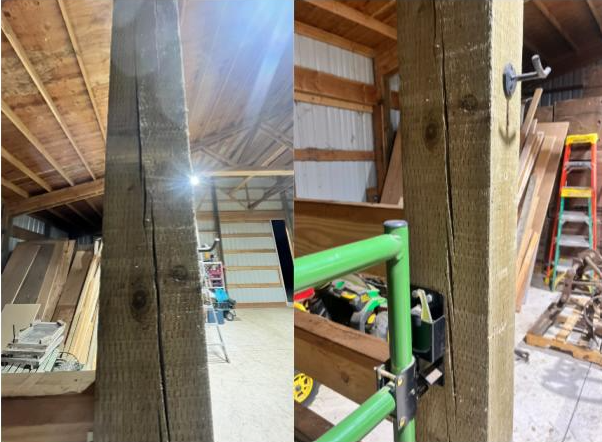
Now you are witnessing just one of a myriad of reasons Hansen Pole Buildings provides true glulaminated columns for all roof supports. Stronger, straighter, lighter weight and nearly impervious to checks and splits. Structural standards for timber typically address load-carrying capacity, deflection limits, and modification factors for strength-reducing characteristics, rather than establishing a specific “allowable” measurement for checking itself. Checking—separation of wood fibers along grain—is a natural characteristic of seasoning monitored for its impact on a member’s structural integrity, particularly regarding bending and shear stress. Building codes and National Design Specification (NDS) evaluate members based on their adjusted allowable stress rather than prescribing specific dimensions for natural features like checks. Because checks can affect a timber’s ability to resist shear, structural design focuses on ensuring actual demand on member does not exceed its capacity after accounting for material conditions.
Checks and splits are strength-reducing characteristics and can be assessed by qualified professionals to determine if they significantly impair a member’s ability to carry shear loads.
When evaluating existing timbers exhibiting checking, focus is on whether size or depth of checks threatens member’s performance under design loads. While prescriptive codes provide a framework for checking beam capacity, assessing specific site-grown checks often requires an inspection to determine if integrity of cross-section remains sufficient for intended use. A qualified Registered Professional Engineer can determine if a specific check is a standard seasoning characteristic or a structural defect warranting remedial action.
Distinguishing between structural checking and dangerous wood splitting requires evaluating depth, orientation, and severity of separation relative to grain of timber. Checks are natural, shallow surface fissures often under 1/16th inch deep caused by wood’s seasoning process, whereas splits represent a more significant failure of wood fibers and can compromise load-carrying capacity.