Retrofitting Insulation for a Milking Parlor
Reader CALEB in SLEEPY EYE writes:
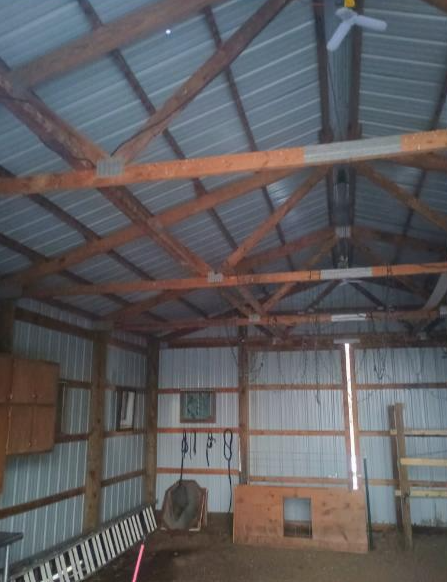
“Hello! So many questions! We have a simple 20 by 30 pole shed we are looking to retrofit into a cow milking parlor on one half and a general purpose/milk equipment cleaning area on the other half. We’ll pour concrete, insulate, and then install steel on the entire interior. We’ll also be removing the current sliding doors, framing in those openings, and adding man doors/windows (I’m hoping that will be fine to frame in on the slab and won’t have frost heave issues?) Currently, the exterior is just metal on wood, no WRB, no soffit or gable vents. The rafters do not seem very substantial and about 8 feet apart, so we are hoping to have a local design build figure out how we can beef them up to support insulation and steel ceiling (unless that’s something you guys can do?). My main questions at this point are with the insulation. I realize this is the age old question, but my hours of research have still left questions. I am hoping to insulate without rigid or spray foam because of price and difficulty of future repairs with spray foam. With foam board, there’s no more drying to the exterior and I would prefer that since this will be a substantial amount of humidity produced in this environment during milking equipment cleanings. Without using foam, it seems I would have to remove steel and install WRB if I hope to have a good air seal, correct? Once there’s a WRB, can I then just use 2×6 walls with fiberglass or mineral wool batts, or insulation blankets? Then vapor barrier, and then steel? This seems to still allow drying to the exterior which I would think to be a good thing. On cold days, will moisture that does make its way into the wall cavity still condense on the WRB? Or does it go through the WRB and condense on the back of the steel? I ask this to try and figure out how much it matters if I do fiberglass or mineral wool batts. As for the ceiling, after adding gable vents, would I be fine with just blow in fiberglass on top of the new flat steel ceiling? I am not sure how to address the condensation on the current roof steel without pulling all that up and adding the reflective insulation you mention in other posts, or spray foaming. I suppose all of that above could be summed up in the questions, what would be the best way to insulate a bare bones Minnesota pole shed without foam? And, if you think foam would make more sense to add, what would be the best way?
Thank you.”
By the time you get done retrofitting this building, you could start from scratch and build a new building for less. And – it would be exactly as it should be, not sort of like.
Assuming you are dead set upon utilizing this building….please read on.
Before pouring concrete for your slab, excavate between columns and install minimum R-10 rigid insulation at least two feet down and two feet out around entire perimeter. This will assist in mitigation of potential frost heaves. Under slab should have same insulation from wall-to-wall with a minimum 10mil vapor barrier on top of insulation and beneath concrete.
Walls – remove wall steel and place a well-sealed omni-directional WRB between framing and siding. Add 2×6 girts bookshelf style between columns flush to inside of posts. These girts will both provide an insulation cavity and will also serve as framing to support your interior liner steel panels. Then place R-30 Rockwool batt insulation between wall girts. This wall assembly will dry to building exterior. Moisture passing through your wall, should pass through WRB and may condense on inside of wall steel, leading to it either evaporating or running down inside of wall steel and out through bottom of siding.
At a 20′ span, roof trusses do not have to look very substantial in order to be strong enough to carry a decent amount of load. With specific information on how those trusses are built, we may be able to run them on our truss design software to determine if they would be adequate to support a ceiling load. We would typically have wanted to have raised heel trusses, so full depth of insulation can run from wall-to-wall.
Roof is going to pose some challenges, as there is no provision to prevent condensation from appearing on underside of steel roofing. If it were my own, I would have two inches of closed cell spray foam applied directly to underside of roof steel. Add gable and ridge vents. Then blow in R-60 fiberglass above a steel liner panel ceiling.
You may find it necessary to mechanically dehumidify – there is just no way to guarantee you will not have issues with excess humidity, given how you intend to use building.