If you didn’t read my blog yesterday – it might help you to back up a day and read where the following blog got started. I nice young gentleman asked me to help him with his boy scout Eagle project – constructing an equestrian barn. So back up a day – then continue here after you get measurements taken and batter boards set up….
Digging Holes
Temporarily remove string lines. If building in an area requiring inspections, call your building inspector to schedule a hole inspection.
This is important! Get off on the right foot with building inspectors. Call for all required inspections!
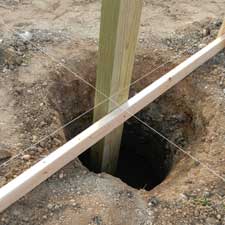 Confirm hole diameter from building plan. While usually 18-or 24-inch diameter, verify from building plans.
Building holes may be made larger in diameter or greater in depth (provided posts are long enough) without adversely affecting building structure. Digging holes which are too small in diameter, or not to depth shown on building plans, could cause a myriad of future structural issues – or even a building failure.
Why would smaller diameter holes be an issue? The building weight, including a “loaded to failure” roof load, must be adequately distributed to soil beneath the concrete around columns. Hole diameters specified on building plans include a sufficient area to resist settling, given stated soil strength. Avoid the temptation to use concrete “cookies” placed beneath columns, as they also do not offer enough surface area to resist settling.
To help prevent frost “heave”, dig holes so width at top is less than width at bottom. This can be done by “belling” out hole bottom with a shovel.
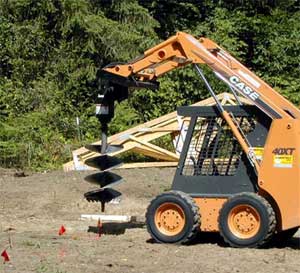 Using an auger mounted on a skid steer, bore holes to depth required on building plans. Holes slightly larger in diameter than auger bit can be created by first digging a pilot hole then offsetting auger slightly from hole center and boring again.
NOTE: High water tables or water in holes will not cause premature decay of pressure preservative treated columns. Treatment is for structural in ground use, which includes being exposed to ground water.
Helpful hint – an auger will NOT remove any rocks larger than half the auger bit diameter.
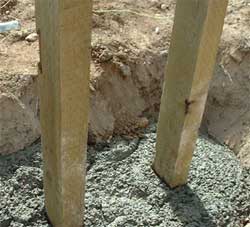 In cases where two adjacent posts will be located in close proximity to each other, the two holes may resemble a short “trench”. This is acceptable.
Holes maybe dug larger in diameter than what is shown on building plans, as well as oblong or rectangular. Dimensions stated on plans are “minimum” requirements.
Do not “over dig” holes! If holes are too deep, extra concrete will be needed and concrete is expensive fill! A visible marker, placed on the auger bit at required depth, is often helpful. If large rocks are present, dig holes with a backhoe, mini- excavator or other similar equipment.
Extend hole depth below area frost line. If unsure about frost depth, ask the local building inspector.
After digging holes, clean any loose material from hole bottoms.
Setting building columns into “sonotubes” or other forms is not recommended. Use will lower the friction coefficient which is created by the concrete encasement cast against native soil. This may adversely affect building performance (or longevity).
Hansen Buildings’ engineers also do not recommend concrete “cookie” placement or pouring concrete “punch pads” at hole bottoms, beneath columns. With column holes properly backfilled with poured concrete, both “cookies” or “punch pads” are usually both structurally inadequate and a needless expense.
There you go – the first big step is done – and you are ready to position columns in the holes. Once again – this may be the time to call your building inspector for a hole inspection.
Good Luck and Happy Digging Holes!





I am building a 2 story 26×26 covered pavilion. foundation plan calls for 16 6×6 treated posts. the plans call for 2ft diameter by 1 ft deep footers. 42″ below grade.
Is it ok to pour the footers, then later set and brace posts and pour a 10″ collar to anchor the post. then fill remaining depth with crushed stone?
just seems easier to have the post sit on the footer to align and brace. doing this alone.
thanks for your help
Stan
You could either do this, or suspend the posts by use of bracing 12″ above the bottom of the hole and monopour 22″ of concrete to be able to do a single pour.
This may seem like a stupid question–but…I have a garage/barn that was likely build around 1900, possibly a bit earlier. It is 17×22, with full loft, with floor and 6′ height in the middle. It has had 3 layer of asphalt roof shingles applied over the years. It was built directly on the ground. The foundation consists of a (approximately) 6×6 timber base, laid on the ground, which form the sill plate. Supporting posts attach to the horizontal sill timbers.
The sill timbers are totally shot and rotted, and I am looking at how to repair the structure. So, my question: why is it all the current codes/recommendations insist that footers to the frost line be installed, or, posts installed to 3-5 feet? While I appreciate such methods may result in a longer serviceable lifespan, (the operative word being “may”) the fact is, the builders of my barn 125 years ago built a structure that stood the test of time just fine. Yes, the sill beams are shot. But they did last 100+ years directly on the ground. Seems ridiculous to have to go to such lengths to repair this structure to meet current codes, when the old methods worked just fine. Given the expense of retrofit, I am literally looking at having to destroy a beautiful old structure in order to fix the base structure.
The concern is for frost heave. You could likely address location of each vertical supporting post individually. Temporarily support building at that point, cut off offending rotted timber base. Excavate for a pier to below frost depth, and pour hole full of premix concrete, placing a wet set bracket in top of pier to attach to vertical support column. Other than your labor, this should not be intensely costly to solve.