Will My Purlin-To-Truss Connection be Adequate Against Uplift?
Reader CHRIS in RICHMOND writes:
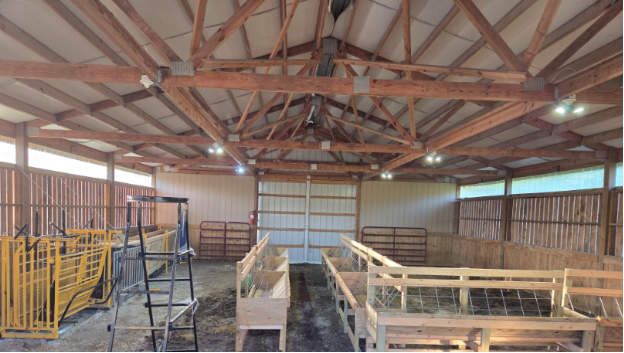
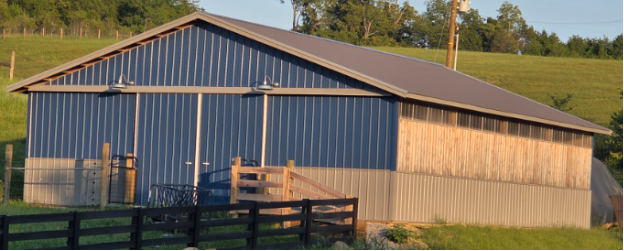
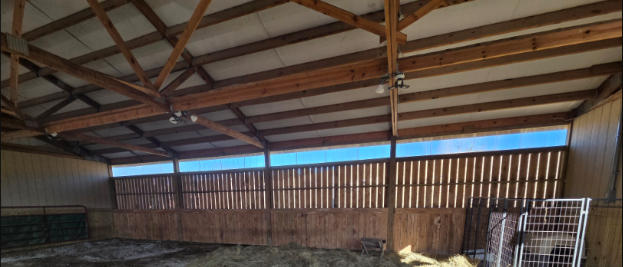
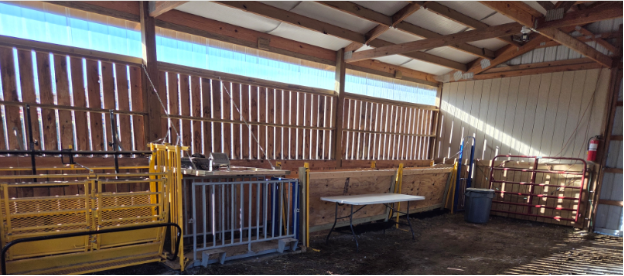
“Hi there. I’ve built a sheep barn leaning heavily on your methods and ideas. I absolutely love it. Our farm was struck by a tornado four years ago. We are now building a hay shed to store all of our feed. As the name implies, it’s a three sided shed with an open front. The double ply trusses are spaced 12′ with 2×6 purlins every two feet. My question is this, I am worried about keeping the roof sections tied together for uplift resistance. I’m not finding much information. But, it seems to me that the joist hangers alone would not be enough to keep the roof sections tied together as a single unit. True, the trusses will be sitting inside a notched post with engineered lag screws to hold them down tight. But, I still wonder if it would be beneficial to use LSTA straps across the trusses to the purlins to connect them a little more. What are your thoughts? For what it’s worth, the open front is facing opposite of the prevailing winds. Size is 36′ wide and 30′ deep. 15 foot eave in the back and 19 foot eave in the front.”
Here are Simpson’s load tables:
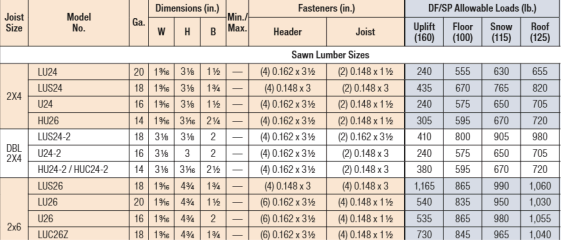
Assuming you have used LU26 hangers, they will support 535 pounds of uplift force. Checking for Ultimate Wind Speed (V) of 190 mph, with an Exposure C and Building Partially Enclosed
F: Maximum allowable uplift force on hanger
F = 535 lbf
R: Maximum reaction force exerted on hanger
R = (le / 2) × sf × D + Wu
R = (141″ / 2) × 12″ × -0.325 psi
R = -274.74 lbf |R / F| ≤ 1.0
|-274.74 lbf / 535 lbf| ≤ 1.0
0.514 ≤ 1.0
Your roof steel will buckle before purlin to truss connection.