Remediating Pole Barn Sliding Door Frost Heaves
Reader MARK in MARINE ON ST. CROIX writes:
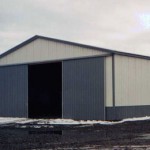 “Poll barn door two 12 foot slider’s how to prevent frost heave s can’t open or close do I dig out under them and pour concrete or put 2 inch styrofoam any ideas?”
Harris Hyman, P.E. wrote this in a July 1994 article in Practical Engineering:
“As an engineer, I want to understand a little about the problem before I recommend corrective measures. Research work on frost heaving is somewhat limited, but there is a theory. Around the end of winter in cold regions, the earth develops a characteristic temperature profile: At the surface, the earth takes on the day’s temperature. But a couple of inches below, the ground temperature cools to approximately the February average temperature of the region. As we go deeper into the earth, the temperature rises, until several feet deep it reaches the annual mean temperature of the area.
The soil usually reaches its coldest temperature in March, when the freezing point reaches down to the region’s frost line. Below this depth, the soil and groundwater almost never freeze. But at the frost line — the 32°F point — the groundwater freezes, forming a thin sheet of ice. In soils that are porous enough to allow moisture to move, more groundwater touches this ice. The groundwater accumulates, freezes, and builds up into a bulge called an ice lens, which might be anywhere from several inches to a few feet across. The bulging ice lens pushes the earth above up into a frost heave. Aggravating the effect is surface melting, which also occurs at the end of March. The snow melt water moves through the ground, touches the ice lens, and adds to the bulge.
This is why, every spring, rural roads up North develop sinuous dips and dives. The ice lenses form during the winter, pushing up spots on the asphalt surface. When the weather warms sufficiently to melt the ice lenses, the unsupported asphalt sags and leaves low spots and potholes. On major highways, which cost a lot more to build, the base layer is sufficiently permeable to carry away groundwater, so heaves are rare.
Ice is fierce stuff. While most substances expand as they become warmer, ice actually expands as it gets colder, with the maximum expansion at about 28°F. When ice is confined, it can exert pressures from 20,000 to 80,000 pounds per square foot. There is almost no way to contain pressures like this; other solutions must be found.
The theory about ice lenses corresponds pretty well with the experience of engineers and excavating contractors. The most interesting implication is that heaving needs two things: cold and water.
This fact gives us our solution: Remove the water. Drainage is the one solution to heaving that does work most of the time.”
I would start by getting rid of any water. Slope ground away from building by at least 5% for 10 feet. Gutter downspouts need to discharge at least 10 feet away from building. Consider a French drainage system.
If this does not solve your issues, you could excavate to below frost line (I have had frost over seven feet deep not far away from you in Northeast South Dakota) and pour a concrete wall across your opening. If wall was thicker at base than top would also help minimize heave potential. Or, you could attempt to solve by pouring a concrete wall say 30″ deep, then insulate each side of wall down two feet and then out horizontally two to four feet with R-10 or thicker rigid insulation boards. Why both sides? I am assuming your pole barn does not have a concrete slab on grade and is unheated.